How to License a CubeSat: The Permits a Small Satellite Needs Before Launch
How to license a CubeSat: the FCC amateur, experimental and small satellite routes, the ITU filing, debris plans, NOAA camera licences and FAA payload checks.
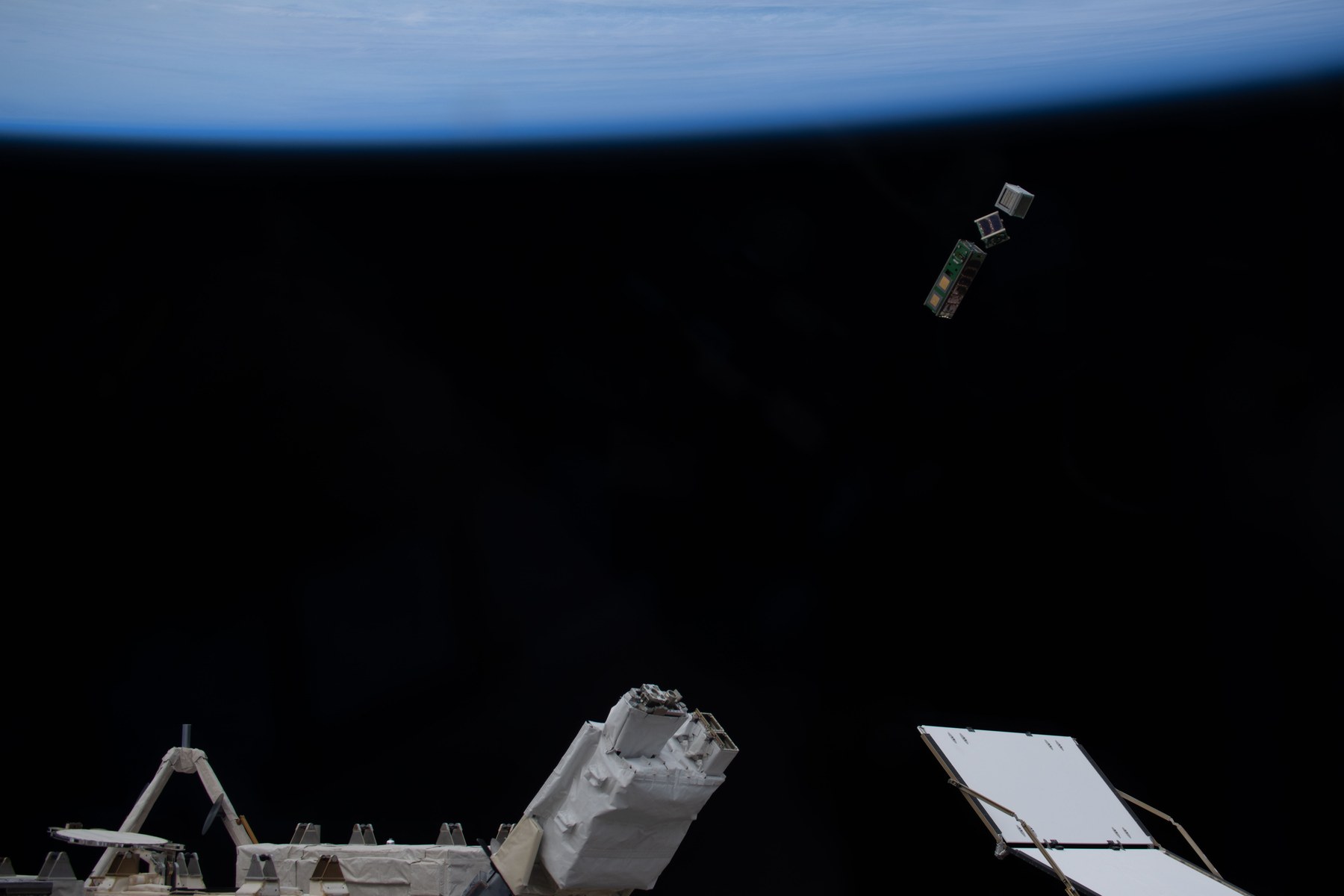
The photograph above shows three CubeSats leaving the International Space Station in February 2026, built by students in Mexico, Italy, Thailand, Malaysia and Japan. Each is about the size of a shoebox. Each also needed paperwork from at least one government before it was allowed to switch on a radio.
That surprises many first-time teams. How do you license a CubeSat? The real answer is that you assemble a stack of approvals, and the order matters. This guide walks through them for a US team, because the FCC’s process is the one most often asked about, and flags where other countries differ. It is a general explanation, not advice on a particular mission.
Start with the right country
Under Article VI of the Outer Space Treaty, States must authorise and continuously supervise the space activities of their nationals. So the first question is not which rocket, but which government is responsible for you. A UK university, for example, deals with the Civil Aviation Authority. A US team deals with several agencies at once.
In the US there is no general mission licence for a satellite. The authorisation that carries most of the weight is the radio licence, because a satellite that cannot transmit cannot be commanded, tracked or heard.
The radio licence: three FCC routes
The FCC set out the options for small satellites in a 2013 public notice, Guidance on Obtaining Licenses for Small Satellites (DA 13-445). The structure still holds.
Amateur, under Part 97. A satellite can be an amateur space station if it uses amateur-satellite bands and is controlled by a licensed amateur operator. The catch is purpose. The amateur rules in section 97.113 bar communications in which the licensee or control operator has a pecuniary interest, so a commercial mission does not belong here. There is no licence document as such. Instead, under section 97.207, the operator files notifications with the FCC before launch, after launch and when transmissions end. The 2013 notice says the pre-launch filing is due no later than 30 days after the launch vehicle is chosen and no later than 90 days before integration. The FCC also expects a letter showing frequency coordination by the International Amateur Radio Union, whose satellite coordination panel handles requests.
Experimental, under Part 5. This is the usual home for university research and technology demonstrations. Operation is on a non-interference basis, so you get no protection if someone else’s signal interferes with yours. The 2013 notice says experimental licences run for two or five years, and missions of six months or less can use special temporary authority instead. The FCC “strongly recommends” the same 30 and 90 day lead times as the amateur route.
Commercial, under Part 25. The FCC also offers a streamlined small satellite licence. Under section 25.122, an application can cover 10 or fewer non-geostationary satellites, each with a mass of 180 kg or less including propellant and at least 10 cm in its smallest dimension, with an in-orbit lifetime of six years or less. Each satellite must either be deployed at or below 600 km or carry propulsion for collision avoidance and deorbit. The applicant also certifies a collision probability of 0.001 or less with large objects, re-entry with zero probability of human casualty, a unique telemetry marker and the ability to stop transmitting on command.
Which route fits depends on what the mission is for, not on the size of the satellite. A paid Earth observation demonstrator is commercial even if a university builds it.
The ITU filing
Every satellite frequency assignment has to be filed with the International Telecommunication Union, and only governments can file. In the US, the FCC submits filings for non-federal satellites. The FCC requires the ITU filing information, along with an orbital debris plan, before it grants an experimental licence. We explain the wider system in our piece on ITU spectrum and orbital slots.
Small missions get a lighter track. Under Resolution 32 (WRC-19), a “short duration mission” is limited to 10 satellites and a validity period of no more than three years from bringing into use, with no extension. A footnote says each satellite should not normally exceed 100 kg. The administration publishes early orbital information and files the notification after launch, no later than two months after bringing into use, and the launch date counts as the date of bringing into use. The satellites must be able to stop transmitting immediately if they cause harmful interference.
Orbital debris: the part teams underestimate
All three FCC routes require an orbital debris showing. The 2013 notice said an assessment prepared to NASA standards “is generally sufficient”, and asked teams to address design for demise, coordination with crewed spacecraft if the satellite manoeuvres near them, and whether surviving debris creates any casualty risk.
Since then the bar has risen. The FCC’s rule that satellites in low Earth orbit should leave orbit within five years of the end of the mission is the big one, and we cover it in our note on the FCC five-year deorbit rule. For a CubeSat without propulsion, the deployment altitude effectively decides whether the plan works. Section 25.122 reflects the same logic by tying its streamlined route to deployment at or below 600 km unless the satellite has propulsion.
Cameras: the NOAA question
If your satellite carries a camera pointed at Earth, ask whether you need a licence from NOAA’s Commercial Remote Sensing Regulatory Affairs office. The regulations in 15 CFR 960.4 define a private remote sensing space system as an instrument “capable of conducting remote sensing” that is not owned by a US government agency, together with the components that support it.
NOAA’s FAQ says it is unlawful for anyone subject to US jurisdiction to operate such a system without a licence. It tells teams who are unsure to submit an Initial Contact Form. Once an application is complete, NOAA “must issue its determination within 60 days”, and there is no filing or licence maintenance fee. Our guide to the NOAA remote sensing licence explains the tiers.
The launch and the FAA
You do not need your own FAA launch licence for a CubeSat riding on someone else’s rocket. The launch operator holds that under the FAA’s Part 450 rules. But the FAA must still review each payload. Under 14 CFR 450.43, a favourable payload determination requires that the owner or operator holds all required licences, authorisations and permits. The FAA does not re-examine the aspects of a payload regulated by the FCC or the Department of Commerce. In practice, your launch provider will ask for your FCC grant before integration.
Some US teams fly for free. NASA’s CubeSat Launch Initiative is open to US educational institutions and non-profit organisations, including museums and science centres, whose missions benefit NASA. It has launched more than 150 CubeSats on more than 40 ELaNa missions. A free ride does not remove the need for your own radio licence.
Export controls under the EAR or ITAR can also apply before you share designs with foreign partners or ship hardware to a foreign launch site.
What happens if you skip a step
The best-known case is Swarm Technologies. According to ARRL’s report, the FCC denied Swarm’s application in December 2017, partly over concerns about tracking satellites a quarter of a standard CubeSat unit in size. Four SpaceBEE satellites were launched from India on 12 January 2018 anyway. In December 2018 Swarm agreed to pay $900,000, adopt a compliance plan and file pre-launch reports with the FCC for three years.
The lesson for student teams is less about the fine than about the launch. Providers now check paperwork closely, and a missing grant can cost you your slot.
The FCC’s rules are changing
In July 2026 the FCC adopted a new Part 100 to replace Part 25, with a default 20-year licence term in place of the current six years for small satellites. It is not yet in force. The Space Bureau’s October guidance, DA 26-1080, says that before the Effective Date “all current part 25 rules will control”, and I found no Federal Register notice setting that date as of 7 November.
The Further Notice published on 26 October at 91 FR 67225 proposes a new subpart J in Part 5 for space-related experimental licences, processed by the Space Bureau, with a route to convert a successful experimental licence into a full authorisation. We set out the detail in our piece on the Part 100 Further Notice. Comments are due on 25 November 2026 and replies on 28 December 2026.
What I would watch
The first is the Part 100 effective date. Teams planning a commercial filing in 2027 need to know which rule book their application will be judged under, and when the longer licence term starts to apply.
The second is the experimental proposal. A single space-specific experimental process would help university teams, who now sit in a general rule part written mainly for terrestrial tests. I would watch how the FCC deals with objections that experimental satellites get no public notice before grant.
The third is the FCC’s tentative view, in the same Further Notice, that every satellite it licenses should keep a US-based control point. If that reaches experimental and student missions run from foreign partner universities, it would change how international CubeSat collaborations are organised.
Questions people actually ask
Do you need a licence to launch a CubeSat?
Yes. In the US a CubeSat normally needs an FCC radio authorisation, an ITU filing made through the FCC, and an orbital debris plan. A NOAA remote sensing licence may also be needed if it carries an Earth-facing camera. The launch provider holds the FAA launch licence.
Can a university CubeSat use an amateur radio licence?
Only if the mission fits the amateur service. Part 97 bars communications in which the licensee or control operator has a pecuniary interest, and the satellite must use amateur-satellite bands under a licensed amateur’s control. The FCC also expects coordination through the International Amateur Radio Union.
What is the FCC small satellite licence?
It is a streamlined Part 25 process under 47 CFR 25.122 and 25.123. It covers up to 10 non-geostationary satellites of 180 kg or less, at least 10 cm in their smallest dimension, with in-orbit lifetimes of six years or less, deployed at or below 600 km or with propulsion.
How early should a CubeSat team apply to the FCC?
The FCC’s 2013 guidance says amateur pre-launch notifications are due no later than 30 days after the launch vehicle is chosen and no later than 90 days before integration. It strongly recommends the same targets for experimental applications. Many teams start much earlier.
Does a CubeSat with a camera need a NOAA licence?
Possibly. NOAA licenses private remote sensing space systems operated by anyone subject to US jurisdiction. Its FAQ asks unsure teams to file an Initial Contact Form. NOAA must decide within 60 days of a complete application and charges no fee.
What happens if you launch a satellite without FCC approval?
You risk enforcement. Swarm Technologies launched four small satellites in January 2018 after the FCC denied its application, and in December 2018 agreed to pay $900,000, adopt a compliance plan and file pre-launch reports for three years.

Anuj KumarEditor-in-Chief
Anuj Kumar is the founder of Legal Desire Media and publishes Fashion Law Journal and Space Law Journal.
Space Law Journal is a joint initiative of Legal Desire Media and Odyogeek. Spotted something we got wrong, or want to respond? Write to space@legaldesire.com.