Active Debris Removal Law: Why You Cannot Simply Clean Up Someone Else’s Space Junk
Active debris removal law: why a dead satellite still belongs to its State and owner, whose consent you need, who is liable and how the UK and US license it.
ESA’s Space Debris Office counts about 47,270 objects regularly tracked by space surveillance networks and estimates that 1.5 million pieces of debris between 1 cm and 10 cm are in orbit, according to its space debris by the numbers figures, last updated on 13 November 2026. ESA’s Space Environment Report 2026, published on 14 September, concludes that prevention alone “is no longer enough” and that “active debris removal must become part of the solution and soon”.
The engineering is catching up; the law is harder. If a company builds a spacecraft that can catch a dead satellite, may it collect someone else’s? Not without permission. This explainer sets out why, and how regulators and the first missions are dealing with it as of November 2026.
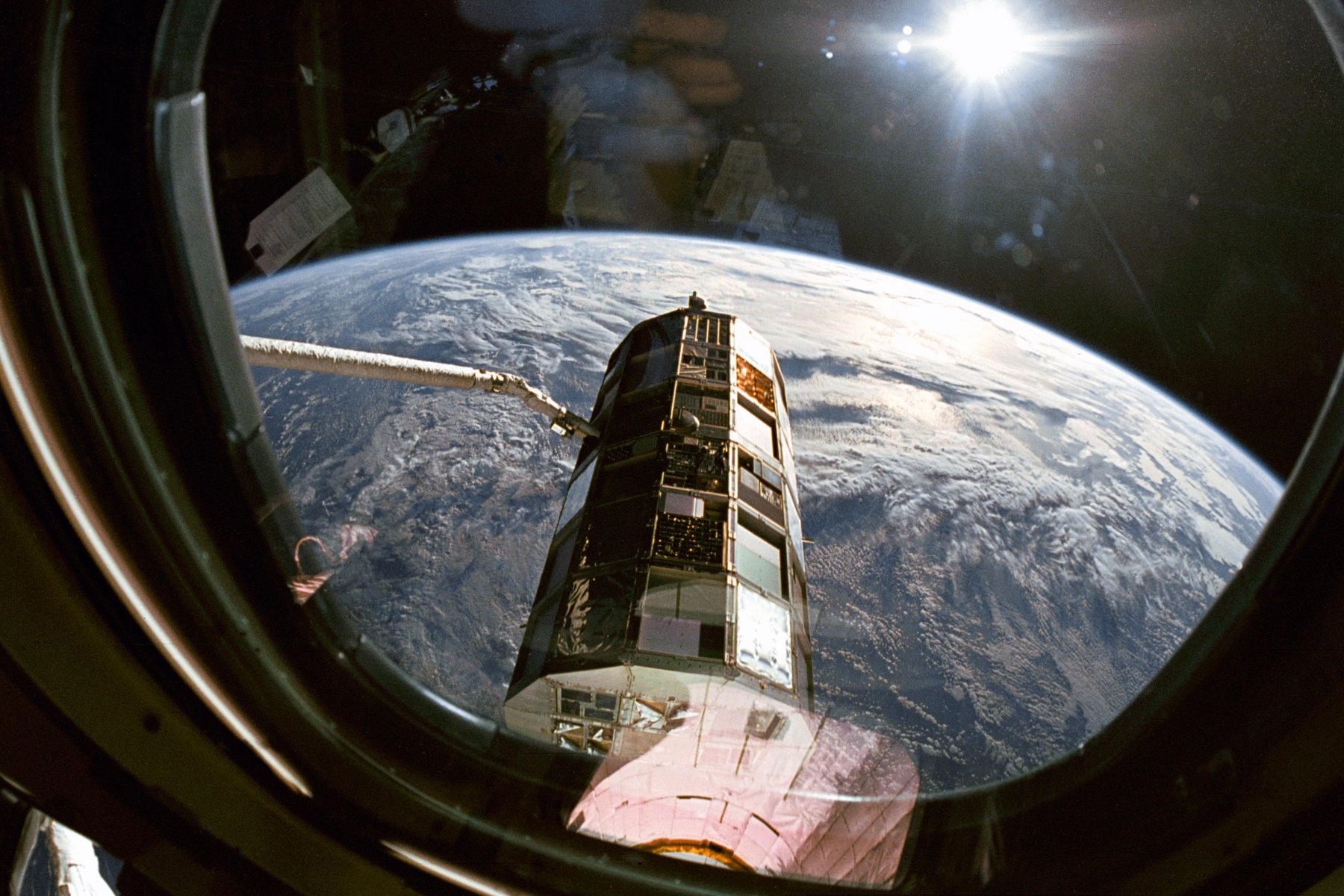
The photograph above shows an older version of the same act. In January 1990 the crew of the Space Shuttle Columbia used the robotic arm to retrieve NASA’s Long Duration Exposure Facility, which a Challenger crew had left in orbit in April 1984. Nobody had to ask: it was NASA’s own spacecraft.
Who owns a dead satellite?
The answer starts with Article VIII of the Outer Space Treaty. A State “on whose registry an object launched into outer space is carried shall retain jurisdiction and control over such object” while it is in space. The next sentence deals with property: “Ownership of objects launched into outer space … and of their component parts, is not affected by their presence in outer space”.
Nothing in the treaty says that jurisdiction or ownership ends when a satellite stops working. Space law has no abandonment rule, no point at which a derelict becomes ownerless and free to take. A dead satellite is still a space object, and so is the upper stage that put it there. The State of registry, which I explain in our Registration Convention guide, keeps jurisdiction and control. The owner, often a company, keeps its property.
This is not only legal theory. A defunct satellite may still carry things its owner wants protected, from proprietary designs to military payloads, and an uninvited grab could look less like a clean-up than a seizure.
The working rule is simple: if it is not yours, you need permission.
Whose permission do you need?
Two layers. The State of registry must agree, because only it can let someone else exercise control over an object under its jurisdiction. The owner must agree, because its property rights survive. Where a company owns a satellite registered by its home State, the remover needs both a contract with the company and that State’s approval.
Japan wrote this into its licensing guidance in 2021. The Cabinet Office’s Guidelines on a License to Operate a Spacecraft Performing On-Orbit Servicing, dated 10 November 2021, say servicing “must be based on a contract with or consent from an entity having all necessary power and authority to modify the current state of the client object, or to dispose of it”. Applicants must identify the owner from the registration records, and a Japanese licence “would never substitute for any procedures that the state of registry/license could impose on the client object”.
The United States has now followed. Under the FCC’s Part 100 rules, adopted on 22 July 2026 in its Space Modernization order, an applicant for a variable trajectory space station licence must certify whether its operations with related spacecraft, a term that expressly includes “spacecraft that have become debris the applicant seeks to remediate”, “will be conducted only with the consent of the operator of the related station”. For objects not licensed in the United States it must give their UN registration details or expected State of registry.
Owner consent does not end the matter. Article IX of the Outer Space Treaty requires States to act “with due regard to the corresponding interests of all other States Parties”. If a planned activity “would cause potentially harmful interference” with other States’ activities, the State must “undertake appropriate international consultations before proceeding”. Capturing a tumbling rocket body in a crowded orbit could meet that test.
Who pays if a removal goes wrong?
The Liability Convention splits the answer by place. For damage “elsewhere than on the surface of the earth”, which covers a collision in orbit, Article III makes the launching State liable “only if the damage is due to its fault”. If a capture breaks up the target and the fragments later hit a third country’s satellite, that country must prove fault, a standard never yet tested before a Liability Convention claims commission.
On the ground the rule is stricter. Article II makes a launching State “absolutely liable” for damage its space object causes on the surface of the Earth or to aircraft in flight, so pieces of a removed object that survive reentry carry liability without proof of carelessness.
Article VII adds a twist: the Convention does not apply to damage a launching State’s object causes to that State’s own nationals. When servicer and target come from the same country, as in the missions flown so far, their exposure to each other is a matter of contract and national law. Our Liability Convention guide explains the wider regime.
Regulators care most about the engineering risk. The US Government’s debris standard practices, quoted by the FCC in its 2024 ISAM proposal, say a removal programme should “(1) avoid fragmentation of the debris structure, (2) limit the probability of accidental collision, and (3) limit the probability of accidental explosion”. A capture that shatters a three-tonne stage would create exactly the cascade described in our Kessler syndrome explainer.
Newsletter
Get Space Law Insider every Monday
One short email a week with the space law news and analysis worth your time. Free, and you can leave any time.
Why does a debris remover worry defence planners?
A spacecraft that can approach, grab and deorbit a dead satellite can, in principle, do the same to a working one. The sensors, capture mechanisms and fuel are the same. That is why close approaches by unannounced spacecraft cause alarm, as I discussed in our piece on Cosmos 2612 and proximity operations.
The answer so far has been transparency. Japan’s Cabinet Office publishes the operator and timing of each servicing mission it licenses, ADRAS-J included. The UN Long-term Sustainability Guidelines, adopted by COPUOS in June 2019 and applied voluntarily, ask States in guideline D.2 to consider new measures to manage debris, and add that “policy and legal issues, such as ensuring that these new measures are compliant with the provisions of the Charter of the United Nations and applicable international law, may also need to be addressed”.
I think dual use, not doctrine, is the main reason removal missions have so far stuck to their own debris. The legal tools for consent exist. What is missing is the trust to let a foreign spacecraft put its arms around your hardware.
How are removal missions licensed?
In the United Kingdom, the Civil Aviation Authority issues orbital operator licences: under the Space Industry Act 2018 for activities carried out from the UK, and under the Outer Space Act 1986 for UK nationals and companies operating from abroad. The CAA’s orbital operator guidance treats a mission involving “close proximity operations or in orbit manufacturing” as novel or complex, and says assessment may take “at least 12 months”. The UK has done this before: Astroscale’s ELSA-d licence was approved by the UK Space Agency on 12 March 2021, ten days before launch.
The United States has no single licence for removal. The FAA licenses launch and reentry, not what a spacecraft does in orbit. The FCC licenses radio transmitters and uses that power to review debris plans. Its February 2024 ISAM proposal would have defined servicing to include “collection and removal of debris on orbit” and asked servicers of foreign satellites for the client’s UN registration and approvals. In July 2026 the FCC folded that work into Part 100, which takes effect on a date its Space Bureau will announce, and closed the ISAM docket.
If the servicer’s cameras can image the Earth, NOAA may need to license them under 15 CFR Part 960; instruments used primarily for navigation are excluded.
None of these agencies authorises the capture itself. That is the US mission authorisation gap: Article VI of the Outer Space Treaty requires “authorization and continuing supervision” of private space activities, but no statute gives any agency the job of supervising one spacecraft grabbing another. Executive Order 14335 of 13 August 2025 told the Commerce Department to propose “individualized mission authorizations” for activities that existing frameworks do not clearly govern. The resulting Office of Space Commerce pilot, announced on 20 August 2026, is voluntary, and a certificate “will have no direct legal effect”. Our piece on the Swift rescue attempt shows what that means for a real mission.
How are the real missions handling consent?
By choosing targets that raise no consent question at all.
| Mission | Target | Why consent is not a problem | Status |
|---|---|---|---|
| ELSA-d (Astroscale) | A client spacecraft launched with the servicer | Astroscale owned both | Launched 22 March 2021; mission completed January 2024 |
| ADRAS-J (Astroscale Japan for JAXA) | H-IIA upper stage that launched GOSAT in 2009 | Japanese object, Japanese programme | Launched 18 February 2024; approached to 15 metres on 30 November 2024 |
| ClearSpace-1 (ESA, OHB-led team with ClearSpace) | PROBA-1, ESA satellite launched in 2001 | ESA removes its own satellite | Launch planned for 2029 |
| ELSA-M (Astroscale UK) | An end-of-life Eutelsat OneWeb satellite | The operator is the customer | Isar Aerospace chosen as launcher in March 2026 |
| UK ADR mission (ClearSpace UK for the UK Space Agency) | Two defunct UK-licensed satellites | UK mission, UK-licensed targets | Contract announced 15 October 2026; launch planned for 2029 |
ADRAS-J was Phase I of JAXA’s Commercial Removal of Debris Demonstration. Astroscale says it launched from Rocket Lab’s New Zealand site and reached 15 metres from the stage, which is about 11 metres long and weighs about three tonnes. JAXA’s programme FAQ gives one reason for the choice of target: “it is an object launched by Japan.” Astroscale plans to launch ADRAS-J2, which is meant to remove the same stage, in fiscal year 2027.
ClearSpace-1 began with an €86 million ESA service contract in 2020, aimed at a Vespa payload adapter left in orbit after a 2013 Vega launch, an “inactive ESA-owned object”. After ESA reported in August 2023 that new objects had been detected near that target, the mission was retargeted at PROBA-1, with OHB now leading the industrial team. Old target or new, ESA has only ever planned to remove its own property.
The UK national mission went out to tender on 3 July 2025, worth £75.6 million, to “capture and safely de-orbit two non-functioning UK-licensed satellites”. On 15 October 2026 the government named ClearSpace UK as its industry partner, with more than £60 million in backing, a 2029 launch from SaxaVord Spaceport in Scotland and both satellites to be removed by 2032. The targets have not been publicly named; whoever owns them will still have to agree.
ELSA-M shows the commercial model. Astroscale UK announced on 16 March 2026 that Isar Aerospace would launch the 520 kg servicer, which “will capture and remove an end-of-life Eutelsat OneWeb satellite”. The owner is the paying customer, so consent comes with the contract.
The policy push points the same way. ESA’s Zero Debris approach says “reliable and affordable Active Debris Removal services need to be demonstrated by 2030”. Twelve countries, the United Kingdom among them, signed the Zero Debris Charter in May 2024, though ESA’s FAQ is clear that “the Zero Debris Charter itself is not legally binding”.
What I would watch
The first is the UK national mission’s licence. The two target satellites have not been named, and the licence will be the first public sign of who owns them and on what terms they agreed to their removal. Whatever the CAA settles on for owner consent is likely to become the template.
The second is Part 100 in practice. The first application to remediate a debris object will show how the FCC treats a target whose operator has gone out of business.
The third is ADRAS-J2. If it removes the H-IIA stage, the industry will have its first removal of a large rocket body, and foreign targets will move from seminars to contract negotiations.
Until some State agrees to let another country’s company take its junk away, active debris removal will mean cleaning up your own.
Questions people actually ask
Is it legal to remove someone else's space debris?
Not without consent. Under Article VIII of the Outer Space Treaty, the State of registry keeps jurisdiction and control over its space objects, even after they stop working. A removal operator needs the agreement of that State and, in practice, of the owner.
Does a dead satellite still belong to anyone?
Yes. Space law has no abandonment rule. Article VIII of the Outer Space Treaty says ownership of space objects is not affected by their presence in space, so a defunct satellite or spent rocket stage remains its owner’s property.
Who is liable if a debris removal mission causes a collision?
Under Article III of the Liability Convention, damage in orbit to another State’s space object is compensated only if the launching State was at fault. Damage on the Earth’s surface or to aircraft in flight is absolute liability under Article II. Damage between parties from the same State is left to contract and national law.
Which agency licenses active debris removal in the United States?
No agency licenses the capture itself. The FAA licenses the launch. The FCC licenses radio use and, under its Part 100 rules adopted in July 2026, asks applicants for its new variable trajectory licence to certify whether they have the consent of the operator of any spacecraft they plan to service or remove. NOAA may license cameras that can image the Earth. A voluntary Commerce Department certification pilot opened in August 2026.
How does the UK license debris removal missions?
The Civil Aviation Authority issues orbital operator licences under the Space Industry Act 2018 for activities from the UK and under the Outer Space Act 1986 for UK entities operating abroad. It treats close proximity operations as novel and says assessment may take at least 12 months.
Which active debris removal missions are coming next?
Astroscale’s ADRAS-J approached a Japanese H-IIA upper stage to 15 metres in November 2024, and ADRAS-J2, meant to remove that stage, is planned for fiscal year 2027. ESA’s ClearSpace-1 is due to launch in 2029 to remove PROBA-1, and the UK national mission, led by ClearSpace UK, is due to launch in 2029 to remove two defunct UK-licensed satellites by 2032.
Space Law Insider
Read the week in space law in five minutes
Every Monday we send one email with the new regulations, filings, cases and explainers published on Space Law Journal. Join practitioners, students and policy people who read it.

Anuj KumarEditor-in-Chief
Anuj Kumar is the founder of Legal Desire Media and publishes Fashion Law Journal and Space Law Journal.
Space Law Journal is a joint initiative of Legal Desire Media and Odyogeek. Spotted something we got wrong, or want to respond? Write to space@legaldesire.com.