The FCC Wants to Auction the Weather Satellite Band: What the 1675-1695 MHz Proposal Means
The FCC voted on 29 October to propose auctioning 1675-1695 MHz, the band NOAA's GOES weather satellites use, for 5G and direct-to-device service.
The FCC’s October open meeting was mostly about phones talking to satellites. A quieter item may matter more to the space sector: a proposal to sell part of the spectrum that America’s geostationary weather satellites use to send data to Earth.
On 29 October the Commission unanimously advanced a Further Notice of Proposed Rulemaking in WT Docket No. 26-284 to auction the 1675-1695 MHz and 2020-2025 MHz bands, as Broadband Breakfast reported from the meeting. The item was listed in the Commission’s Sunshine Act notice alongside the companion direct-to-device rulemaking, which we covered in our piece on the FCC’s plan to rewrite the SCS rules. The adopted text had not been posted when I wrote this, so what follows is based on the draft and fact sheet released on 8 October. The Commission can change items between circulation and adoption.
What the FCC voted to propose
The draft would reallocate 1675-1695 MHz on a co-primary basis for fixed and mobile services (except aeronautical mobile) for new non-federal use, and add a secondary mobile-satellite allocation so that the spectrum could also be used for supplemental coverage from space. The 2020-2025 MHz band, which already has non-federal fixed and mobile allocations and no federal incumbents, would get the same secondary satellite allocation.
The band plan is small: two unpaired 10 megahertz blocks and one unpaired 5 megahertz block. Licensees could use either band for uplink, downlink or time division duplexing. The draft proposes a 15-year licence term, performance requirements for both terrestrial and D2D use, and competitive bidding procedures. Comments will be due 60 days after publication in the Federal Register and replies 90 days after.
The statutory backdrop is the One Big Beautiful Bill Act, Public Law 119-21, signed on 4 July 2025. As the draft explains, it restored the FCC’s general auction authority until 30 September 2034, requires the Commission to license at least 300 megahertz by competitive bidding before then, and requires NTIA to identify 500 megahertz of federal spectrum between 1.3 GHz and 10.5 GHz for commercial or shared use.
Who uses 1675-1695 MHz today
The band is allocated to the meteorological aids and meteorological-satellite (space-to-Earth) services for federal and non-federal users. Footnote US88 to the US Table of Frequency Allocations already lists 14 protection zones for federal earth stations receiving in the band. NOAA has largely moved its radiosondes, the instruments carried by weather balloons, down to 400.15-406 MHz. The FCC describes the 25 megahertz on offer as near greenfield.
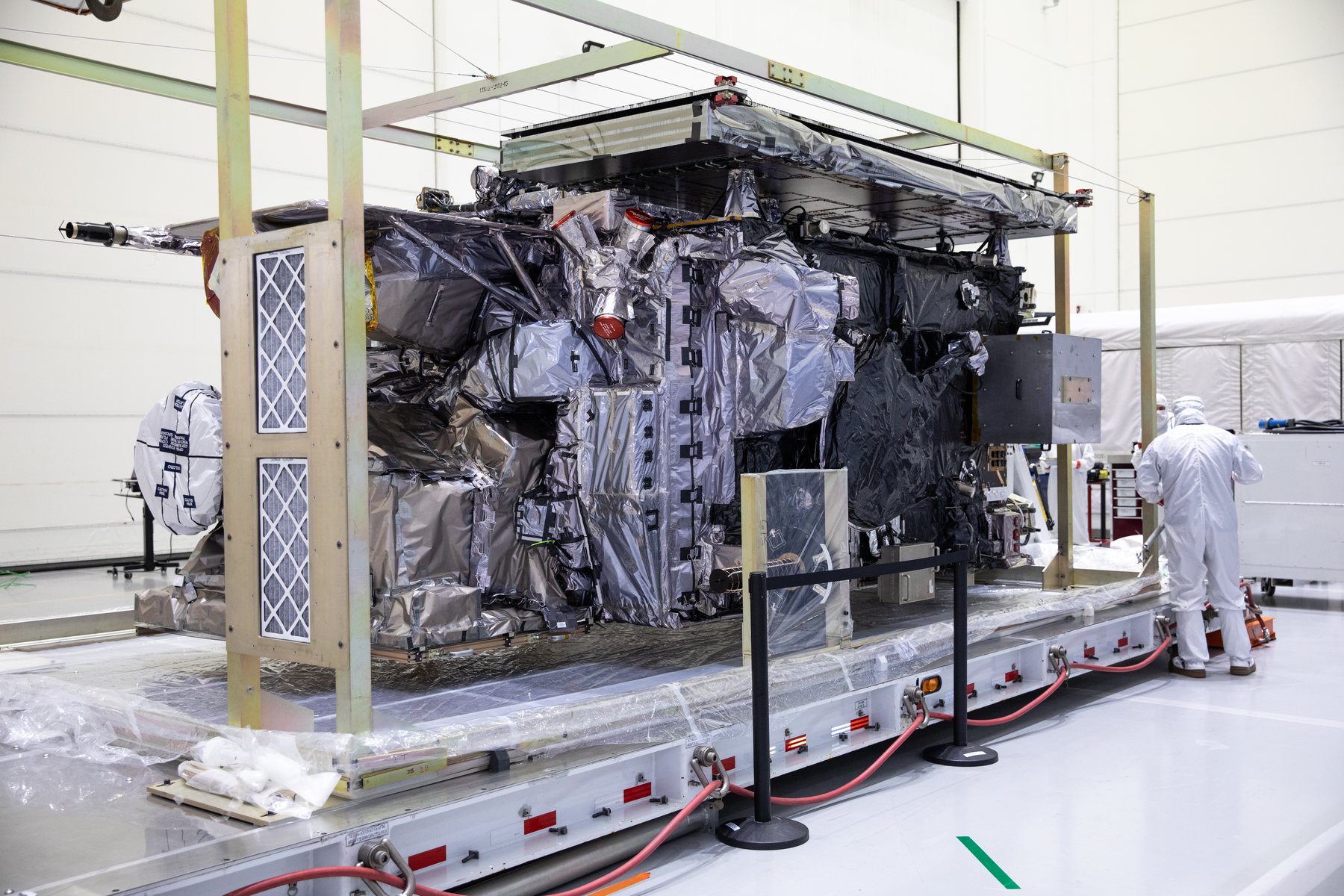
The satellite use is what matters. According to the draft, NOAA’s two operational GOES-R series satellites, GOES-18 (operational since 4 January 2023) and GOES-19 (operational since 7 April 2025), transmit on intermittent channels between 1679.7 MHz and 1694.7 MHz. Three services sit in the band:
The Data Collection System downlink at 1679.7-1680.1 MHz disseminates real-time information on weather, hydrologic and other environmental conditions, and solar activity, to federal, state and local government and private sector users. The GOES Rebroadcast (GRB) service at 1681.15-1692.05 MHz carries the satellites’ sensor data in real time. The High Rate Information Transmission and Emergency Managers Weather Information Network service, HRIT/EMWIN, sits at 1693.5-1694.7 MHz. The draft counts 25 GRB receive sites and 17 HRIT receive sites in the United States.
There is also a defence user. NOAA transferred GOES-15 to the Space Force in September 2023, and it now operates as EWS-G2 over the Indian Ocean on channels from 1673.4 MHz to 1694.8 MHz, expected to remain in service until 2030. Looking further ahead, NOAA’s next-generation GeoXO satellites will use a downlink at 1691.9 MHz once deployed, which the draft puts at approximately 2035.
How sharing would work
This proceeding is not new. The FCC first proposed sharing 1675-1680 MHz in May 2019, in a rulemaking similar to a 2012 Ligado petition. NOAA studied the idea twice. Its 2022 SPRES report found sharing with commercial uplinks “potentially feasible” but said sharing with commercial downlinks was “not viable”. Its 2024 follow-on report concluded that sharing “is feasible” subject to conditions, including protection of redundant federal receive stations and an alternative way of distributing the data.
On 26 February 2026 NTIA wrote to Chairman Carr identifying 1675-1680 MHz as the first of the 500 megahertz the 2025 Act requires it to find. The letter names four federal sites that need protection, at Fairmont, West Virginia; Sioux Falls, South Dakota; Suitland, Maryland; and Wallops, Virginia. Every other receive site would move to an Alternative Distribution System that does not depend on radio spectrum, such as an internet-based system. NTIA also said the band is suitable for terrestrial uplink or downlink, provided downlinks meet the emission limits already used in 1670-1675 MHz.
The FCC’s draft follows that model. Commercial licensees would have to coordinate with NTIA before deploying inside zones around the four protected sites, and would be free of coordination elsewhere. The FCC does not propose the dynamic zones that NOAA’s reports had suggested for periods of atmospheric ducting, citing complexity, though it asks whether they could work. For 1680-1695 MHz it proposes the same mechanism, and asks which GRB, HRIT and future GeoXO sites would need protection and whether the rest could also move to an alternative system.
The tension is plain. NOAA’s 2022 report said downlink sharing was not viable in 1675-1680 MHz. The FCC now proposes allowing downlinks, and D2D satellite transmissions, across a wider band, relying on NTIA’s later recommendations and on emission limits. That gap is where most of the technical comments will land.
Who pays for the alternative system
The Alternative Distribution System is the hinge of the whole plan, and the draft leaves most of it open. NTIA has said it will give the FCC an updated cost estimate six months before any auction. The FCC asks whether auction winners should pay transition costs, operating costs or both, and for how long. It notes Ligado’s suggestion that the licensee fund “the design, deployment, and operation” of the system over the initial ten-year licence term, and asks whether a federal entity should pay instead.
The weather community’s objection is about reliability rather than money. In joint comments filed in February 2025, the American Geophysical Union, the American Meteorological Society and other groups said they had filed more than 120 times in the proceeding. They argued that GRB works in severe weather and, unlike internet-based alternatives, is “not impacted by power and internet outages that are frequent in emergencies”. The FCC’s draft asks directly how an internet or cloud system could meet those latency and reliability concerns.
The legal questions
The first is the ORBIT Act. 47 U.S.C. 765f bars the FCC from assigning by competitive bidding “orbital locations or spectrum used for the provision of international or global satellite communications services”. The draft tentatively concludes that the Act does not stand in the way, because the primary use would be terrestrial, satellite use would be secondary, and D2D service is likely to come from non-geostationary satellites serving domestic customers. It relies on earlier decisions treating direct broadcast satellite and MVDDS spectrum as outside the bar. I think that reasoning is sound for this band, but it will be tested if the FCC later auctions spectrum where the satellite use is primary.
The second is sequencing. NTIA has not finished its study of 1680-1695 MHz and hopes to report within the statutory deadline of 4 July 2027. The FCC says it will refresh the record once the study is done and that its “ultimate actions” depend on it. Chairman Carr memorialised the FCC’s plan to auction some or all of the band in a letter to NTIA dated 11 September 2026. Proposing service rules for 20 megahertz when NTIA has identified only 5 puts pressure on the federal side to agree.
The third is the meaning of secondary status. A secondary D2D operator may not cause harmful interference to primary services and cannot claim protection from them. In a band whose primary users include federal meteorological satellites, that is a real constraint on satellite operators, not a formality. Readers who want the split between the FCC and NTIA explained should start with our guide to who regulates space in the US.
Why satellite operators are interested
The draft records letters urging the FCC to open these bands from Amazon Leo (1 September 2026), SpaceX (10 August and 3 September 2026) and AST SpaceMobile (9 September 2026), which expressly supported an auction. SpaceX told the FCC these frequencies “can travel farther and sustain mobile connections relatively better than higher-frequency waves”. AST said they “can reach ordinary smartphones with compact antennas”.
At the meeting, Chairman Carr said: “We expect big interest in this seemingly modest amount of spectrum.” Commissioner Gomez, according to Broadband Breakfast, said there were still “important technical questions” about whether satellite and terrestrial users could coexist in the bands.
The Upper C-band transition also moved satellite users aside for terrestrial wireless. The difference here is that the incumbents are federal weather services and their non-federal downstream users, not commercial operators with a reimbursement claim.
What I would watch
The first is Federal Register publication, which starts the 60-day comment clock. The NOAA, NTIA and weather community filings will show whether the four-site model has federal support beyond 1675-1680 MHz.
The second is NTIA’s study of 1680-1695 MHz. If it finds only part of that range can be shared, the band plan will shrink and the D2D case weakens.
The third is the Alternative Distribution System. Until someone puts a number on it and agrees to pay, there is no workable auction. Watch for NTIA’s cost estimate and for whether the FCC makes funding a licence condition.
Questions people actually ask
What did the FCC decide about 1675-1695 MHz on 29 October 2026?
The FCC unanimously advanced a Further Notice of Proposed Rulemaking proposing to auction 25 megahertz in the 1675-1695 MHz and 2020-2025 MHz bands. Licences would allow terrestrial fixed and mobile service on a primary basis and direct-to-device satellite service on a secondary basis. It is a proposal, not a final rule.
Which weather satellites use the 1675-1695 MHz band?
NOAA’s GOES-R series satellites, currently GOES-18 and GOES-19, transmit Data Collection System, GOES Rebroadcast and HRIT/EMWIN downlinks between 1679.7 MHz and 1694.7 MHz. The Space Force’s EWS-G2, formerly GOES-15, also uses the band, and NOAA’s future GeoXO satellites will use 1691.9 MHz.
How would weather data users be protected?
The draft proposes coordination zones around four NOAA receive sites at Fairmont, Sioux Falls, Suitland and Wallops. Other users would receive data through an Alternative Distribution System, such as an internet-based one, developed by NOAA. Who pays for that system, and how reliable it will be during storms and outages, are still open questions.
Has NTIA approved commercial use of the whole band?
No. On 26 February 2026 NTIA identified only 1675-1680 MHz for commercial use under the One Big Beautiful Bill Act. It is still studying 1680-1695 MHz and hopes to report by 4 July 2027. The FCC says its final decisions will depend on that study.
Does the ORBIT Act stop the FCC auctioning this spectrum?
The FCC tentatively concludes it does not. The ORBIT Act bars auctions of spectrum used for international or global satellite services, but the FCC says the primary use here would be terrestrial and satellite D2D use would be secondary, domestic and likely non-geostationary. Commenters can challenge that view.
When are comments due on the 1675-1695 MHz proposal?
Comments are due 60 days after the Further Notice is published in the Federal Register, and reply comments 90 days after publication. As of 1 November 2026 the notice had not yet been published, so the exact dates were not fixed.

Anuj KumarEditor-in-Chief
Anuj Kumar is the founder of Legal Desire Media and publishes Fashion Law Journal and Space Law Journal.
Space Law Journal is a joint initiative of Legal Desire Media and Odyogeek. Spotted something we got wrong, or want to respond? Write to space@legaldesire.com.