Planetary Protection Explained: The Rules That Keep Earth Life Off Other Worlds
Planetary protection explained: Article IX, COSPAR's five categories, the 2026 Icy Worlds update, and why private missions remain a regulatory gap.
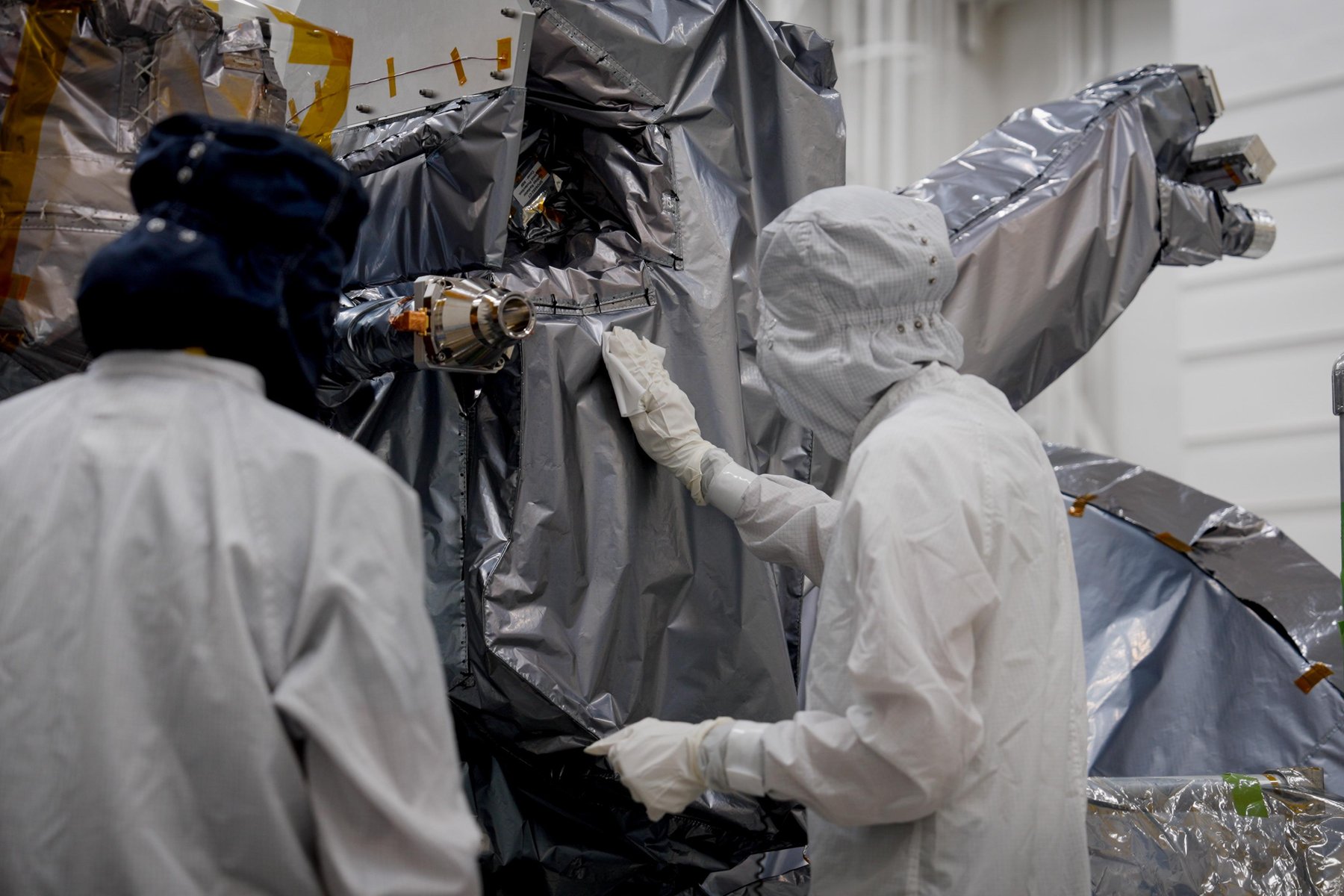
Every spacecraft that leaves Earth carries life with it, whether or not anyone intends it to. Clean rooms cut the number of bacterial spores on a lander, but they do not make it sterile. Planetary protection is the body of rules that decides how clean is clean enough for each destination, and what precautions apply when material comes back the other way.
It matters for science, because a single Earth microbe found on Mars or Europa could make the search for life there impossible to interpret. It matters for law, because the Outer Space Treaty requires States to avoid harmful contamination, and those States answer for their companies.
Forward and backward contamination
Forward contamination is the risk that a spacecraft carries Earth organisms or organic chemicals to another body, where they could survive, spread, or simply confuse later instruments looking for signs of life. Backward contamination is the risk that a mission returning samples to Earth brings back something biologically active.
NASA’s Office of Planetary Protection sums up the two goals as to “carefully control forward contamination of other worlds” and to “rigorously preclude backward contamination of Earth”. Forward contamination is managed as a probability; backward contamination from places that might host life is meant to be prevented outright.
The legal basis: Article IX
The obligation is in Article IX of the Outer Space Treaty. States parties “shall pursue studies of outer space, including the Moon and other celestial bodies, and conduct exploration of them so as to avoid their harmful contamination and also adverse changes in the environment of the Earth resulting from the introduction of extraterrestrial matter and, where necessary, shall adopt appropriate measures for this purpose.”
That sentence leaves a great deal open. It does not define “harmful”, set a contamination limit, or say who decides. It also binds States rather than companies. Article VI fills the second gap: States bear international responsibility for national activities in space “whether such activities are carried on by governmental agencies or by non-governmental entities”, and private activities “shall require authorization and continuing supervision by the appropriate State Party”. I go through both articles in our Outer Space Treaty explainer.
COSPAR and its policy
The technical content comes from COSPAR, the Committee on Space Research, a scientific body that has dealt with biological contamination since its inception. Its Panel on Planetary Protection maintains the COSPAR Policy on Planetary Protection, which is the international reference point for every space agency’s rules.
The policy is candid about its legal status. Its preamble says COSPAR maintains it “to guide compliance with the Outer Space Treaty” as “an international voluntary and non-legally binding standard”. It has force only when a State or agency adopts it, through licence conditions, procurement contracts or internal requirements.
The policy states two objectives: the scientific investigation of chemical evolution and the origin of life “must not be compromised”, and “the Earth must be protected from the potential hazard posed by extraterrestrial matter carried by a spacecraft returning from a planetary mission.” It applies to “all entities conducting space activities beyond Earth orbit”, which on its face includes companies.
The panel revises the policy as science changes. The current version, published in Space Research Today in January 2026, was endorsed by the panel on 6 October 2025 and approved by the COSPAR Bureau on 7 November 2025, according to the editorial and policy text.
The five categories
The core of the policy is a classification by mission type and target body, which decides how much documentation, cleaning and analysis a mission needs.
Category I covers targets “not of direct interest” for understanding chemical evolution or the origin of life, such as undifferentiated, metamorphosed asteroids, Io and Mercury.
Category II covers targets of significant scientific interest where there is only a “remote” chance that contamination would compromise future research: Venus, comets, carbonaceous asteroids, the giant planets and the Moon. Missions need a short planetary protection plan and reports on any impact. The Moon is split three ways. Orbiters and flybys are Category II. Landers away from the poles are IIa. Landers going to a permanently shadowed region or the lunar poles, defined as south of 79 degrees south or north of 86 degrees north, are IIb, with stricter documentation of the organic materials they carry. That matters because permanently shadowed craters are where water ice is thought to survive.
Category III covers flybys and orbiters of bodies where there is a “significant” chance of contamination, now Mars and the Icy Worlds. Requirements include clean rooms, trajectory biasing so that the spacecraft and its upper stage do not hit the target by accident, and sometimes bioburden reduction.
Category IV covers landers and probes to the same bodies. Mars is subdivided: IVa for landers without life-detection instruments, IVb for missions looking for extant Martian life, and IVc for missions entering Mars “Special Regions” where Earth organisms might replicate. These missions need bioassays, contamination probability analyses and, for parts that touch sensitive regions, partial sterilisation.
Category V applies to any mission returning samples to the Earth-Moon system, in addition to its outbound category. “Unrestricted Earth return” applies where scientific consensus holds the source has no indigenous life, such as the Moon. “Restricted Earth return”, which applies to Mars, demands “absolute prohibition of destructive impact upon return”, containment of all unsterilised returned hardware and samples, and analysis under strict containment.
The numbers behind these categories are set out in the policy. The default limit is a probability of no more than 1 in 1,000 that a planetary body is contaminated during its “period of biological exploration”, which for Mars is 50 years from launch. Earth organisms are assumed unable to replicate below a water activity of 0.5 or a temperature of minus 28 degrees Celsius.
What changed in 2026: Icy Worlds
The headline change in the 2026 version is a single framework for what COSPAR now calls Icy Worlds: “all bodies with an outermost layer that is predominantly water ice by volume and that have enough mass to assume a nearly round shape.” The old policy focused on Europa and Enceladus. COSPAR’s editorial explains that newer data suggest bodies with deeper or older oceans, such as Ganymede, Titan and Ceres, could also matter.
Four features stand out. First, missions to Icy Worlds are now Category III (orbiters) or IV (landers) by default. A mission team can argue for Category II only by showing that the chance of any part of the spacecraft reaching an environment warmer than minus 28 degrees Celsius within 1,000 years is below 1 in 10,000. The policy cites earlier analyses of that kind for ESA’s JUICE mission to Ganymede and NASA’s Dragonfly mission to Titan.
Second, the trigger for concern is now temperature rather than liquid water, because no known Earth organism replicates below minus 28 degrees Celsius. Third, the period of biological exploration for Icy Worlds is 1,000 years from the start of the 21st century. Fourth, the policy now includes guidance on sample return from Icy Worlds and small bodies, which it previously lacked even for Europa and Enceladus. It also removes the old “Category II*” label, which COSPAR says was “often deemed unclear and difficult to implement”. The new rules do not apply to missions already on their way or in advanced development.
For Europa and Enceladus, the policy expects that the default Category III or IV “will likely be maintained” because their plumes and possible shallow water pockets make the 1 in 10,000 test hard to pass.
How agencies apply it
NASA’s framework is NPR 8715.24, Planetary Protection Provisions for Robotic Extraterrestrial Missions, and NASA-STD-8719.27, the Planetary Protection Standard, which took effect on 30 August 2022 and covers both crewed and robotic missions from early design reviews through to end-of-mission disposal. Crewed missions to Mars raise problems of their own, which I covered in our piece on who would govern a Mars colony.
Backward contamination has a history too. The US National Strategy for Planetary Protection, issued in December 2020, notes that lunar samples “have been deemed non-hazardous and their return to Earth has been unrestricted since 1971”, and that US policy on backward contamination “has not been updated since the Apollo era”.
The private sector gap
The hardest legal question is who checks a private mission. An agency mission follows its agency’s rules. A company’s lunar lander does not automatically follow anyone’s.
The 2020 national strategy said this plainly: “the processes for approving and supervising private sector space missions are currently unclear with regard to planetary protection.” It set a goal to “provide authorization and continuing supervision” of private activities for that purpose, including a review of the interagency payload review process and a framework for approving private sample returns.
The case usually cited is Beresheet, the Israeli lander that crashed on the Moon on 11 April 2019. As The Space Review reported, the Arch Mission Foundation had placed tardigrades in its “Lunar Library” payload without telling the mission’s operators. Its founder told Mashable: “We didn’t tell them we were putting life in this thing.” The authors concluded that the tardigrades’ compliance with planetary protection rules “was not able to be assessed before launch.” The Moon is only Category II, but the episode showed how easily a private payload can slip past the system.
The US has started to address the wider authorisation gap. In August 2026 the Office of Space Commerce opened a pilot for Space Commerce Certifications for novel in-space activities. The pilot page says a certificate granted during the pilot “will have no direct legal effect”, and it does not mention planetary protection. I discussed the pilot in our piece on mission authorization.
What I would watch
The first is the lunar poles. Category IIb already asks more of polar landers, and more States are joining lunar exploration under the Artemis Accords. If water ice becomes a resource, as discussed in our piece on who owns the Moon’s resources, the pressure to keep it scientifically clean will meet the pressure to use it.
The second is how the Icy Worlds framework is applied to the next generation of outer Solar System missions. The first requests for reclassification to Category II will show how strict the 1 in 10,000 test is in practice.
The third is private sample return. When a company plans to bring material back from anywhere other than the Moon, someone must decide whether it is restricted Earth return and who enforces containment. The 2020 strategy asked for that framework; I am not aware of it having been put into binding form.
The fourth is whether planetary protection becomes a formal licence condition for commercial missions. That is the cleanest fix to the Beresheet problem; until then, the policy binds only those who adopt it.
This explainer reflects the COSPAR Policy on Planetary Protection (2026 version) and the other sources linked above as at 23 October 2026. It is general information, not legal advice.
Questions people actually ask
What is planetary protection?
It is the practice of preventing contamination of other worlds by spacecraft from Earth, and of protecting Earth from anything a mission brings back. It rests on Article IX of the Outer Space Treaty and the COSPAR Policy on Planetary Protection.
Is the COSPAR planetary protection policy legally binding?
No. COSPAR describes it as a voluntary and non-legally binding standard. It binds only when a State or agency adopts it, for example in internal requirements or licence conditions. Article IX itself binds States.
What are the five planetary protection categories?
Category I is for targets of no direct interest for the origin of life. Category II is for bodies such as the Moon and Venus where contamination risk is remote. Categories III and IV apply to orbiters and landers at Mars and Icy Worlds. Category V applies to missions returning samples to Earth.
What changed in the 2026 COSPAR policy?
The 2026 version introduces a single framework for Icy Worlds such as Europa, Enceladus, Ganymede and Titan. Missions to them are Category III or IV by default, and the old Category II* label is gone.
Do planetary protection rules apply to private companies?
States are responsible for their companies under the Outer Space Treaty, and the COSPAR policy covers all entities operating beyond Earth orbit. But the US has acknowledged that its process for supervising private missions on planetary protection is unclear.
Why is the Moon's south pole treated differently?
Landers going to permanently shadowed regions or the lunar poles are Category IIb under the COSPAR policy, with stricter documentation of the organic materials they carry, because these regions may hold scientifically valuable water ice.

Anuj KumarEditor-in-Chief
Anuj Kumar is the founder of Legal Desire Media and publishes Fashion Law Journal and Space Law Journal.
Space Law Journal is a joint initiative of Legal Desire Media and Odyogeek. Spotted something we got wrong, or want to respond? Write to space@legaldesire.com.