Space Tourism: Who Flies, What It Costs and What the Law Says About Safety
Space tourism now spans ten-minute suborbital hops, private orbital flights and paid stays on the ISS, at prices from $750,000 to a reported $55 million. This explainer sets out who flies, what it costs, and how US, UK and international law handle passenger safety through informed consent rather than certification.
On 22 January 2026, six people rode Blue Origin’s New Shepard to the edge of space on mission NS-38. Eight days later the company announced it would pause New Shepard “for no less than two years” and move its resources to lunar work. That closed a chapter of 38 flights, 98 seats flown and 92 different people carried, some of whom went twice.
With Virgin Galactic also grounded until its new ships are ready, it is a good moment to take stock. Space tourism has grown from a single $20 million seat on a Russian Soyuz in 2001 into an industry with several operators, a public price list from NASA and a body of law built around one unusual idea: that a paying passenger can be flown on a vehicle the government has not certified as safe, as long as they have been told so in writing and have agreed.
That idea matters to lawyers and operators. It decides who carries the risk, what has to go into a consent form, what a passenger can sue for and how much room the regulator has to step in. This explainer sets out who is flying, what it costs and what the law in the US, the UK and at international level says about safety.
Who actually flies
The word “tourist” covers three quite different experiences.
The first is the suborbital hop. A capsule or spaceplane climbs past the edge of space, gives its passengers a few minutes of weightlessness and a view of the curve of the Earth, and comes straight back down. Blue Origin’s first crewed flight, NS-16 on 20 July 2021, carried Jeff Bezos, his brother Mark, Wally Funk and Oliver Daemen. Funk, at 82, became the oldest person to reach space and Daemen, at 18, the youngest. The NS-31 flight on 14 April 2025 carried an all-female crew and drew a sharp comment from Transportation Secretary Sean Duffy that those on board “cannot identify as an astronaut” under FAA criteria.
Virgin Galactic flies a spaceplane dropped from a carrier aircraft. Its last spaceflight was Galactic 07 on 8 June 2024, the final commercial flight of VSS Unity. In its second quarter 2026 results on 12 August 2026, the company said its first new ship is “now expected to enter commercial service in February 2027 rather than the fourth quarter of 2026”. Its chief executive said in April that about 650 people hold tickets bought at various prices.
The second product is the private orbital flight on SpaceX’s Crew Dragon, which does not stop at a space station. Inspiration4 launched on 15 September 2021 and spent three days in orbit at about 575 kilometres. Polaris Dawn launched on 10 September 2024, reached an apogee of around 1,400 kilometres and carried out the first commercial spacewalk two days later. Both were funded by Jared Isaacman. Fram2, financed by Chun Wang, launched on 31 March 2025 into the first crewed polar orbit and splashed down off California on 4 April.
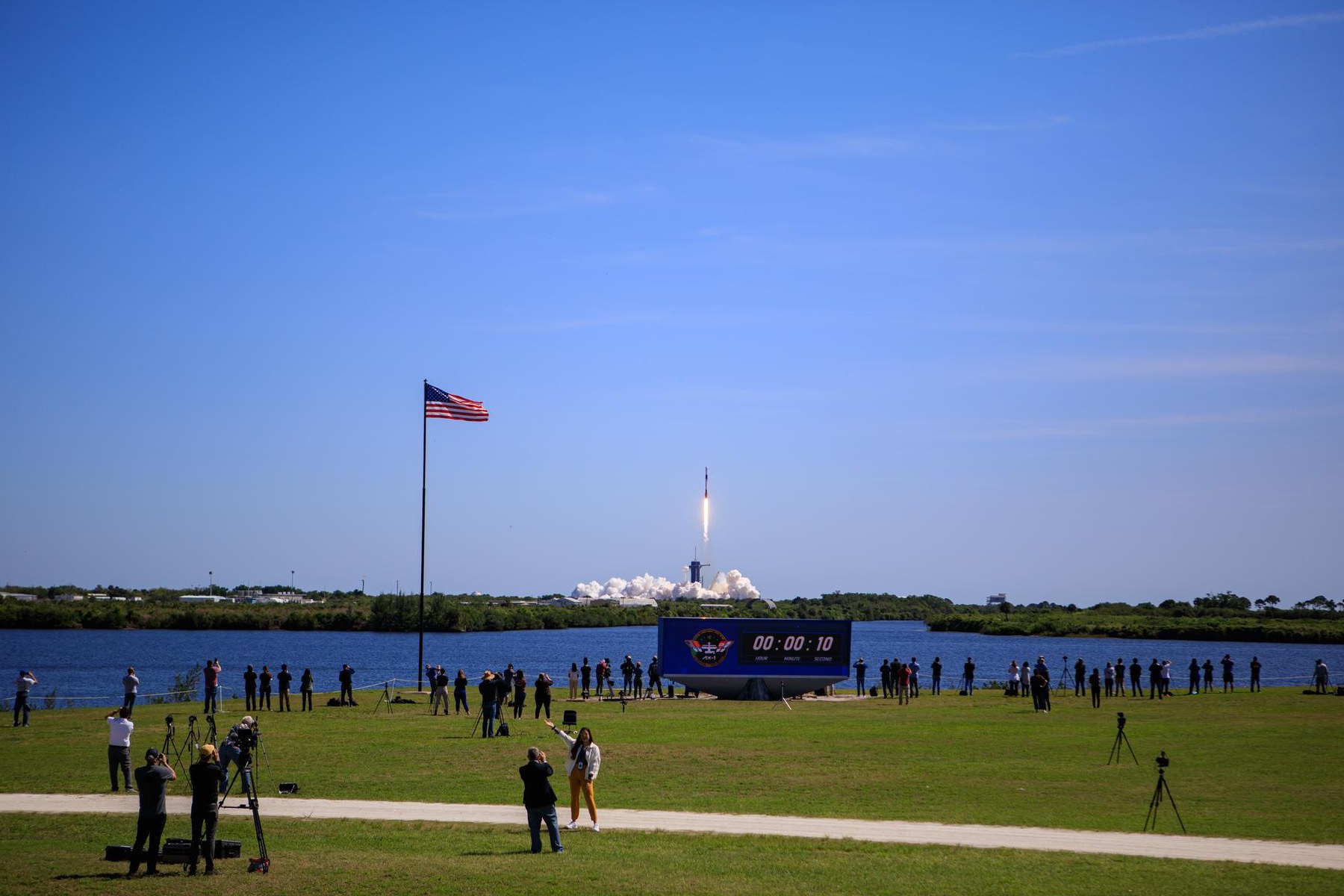
The third is the paid visit to the ISS. Axiom Space has flown four private astronaut missions: Ax-1 in April 2022, Ax-2 in May 2023, Ax-3 in January and February 2024 and Ax-4 in June and July 2025. NASA allows up to two such missions a year. It awarded Ax-5, now listed as no earlier than January 2027, on 30 January 2026, and on 12 February 2026 gave Vast its first ISS mission, a 14-day flight targeting summer 2027. Vast’s own station, Haven-1, is targeted for early 2027.
There is no official count of private flyers. The closest is the FAA’s list of everyone who has passed 50 statute miles on a licensed or permitted flight, which named about 191 people when updated on 9 October 2026. It includes NASA astronauts on commercial Dragon flights, so it overstates the number of tourists. Either way, this is still a very small market.
What it costs
The first tourist, Dennis Tito, launched on a Soyuz on 28 April 2001 and reportedly paid $20 million through the broker Space Adventures. Space Adventures flew seven tourists between 2001 and 2009. When Yusaku Maezawa flew to the ISS on Soyuz MS-20 in December 2021, the price was not disclosed; reports put it above $80 million and he said he paid “pretty much” that.
Prices for suborbital flights are lower but have gone up, not down. Virgin Galactic sold seats for $450,000 in 2021 and $600,000 in 2023, and its most recent tranche was $750,000 a seat. It has said the next one will cost more. Blue Origin has never published a price. The only public figure is the June 2021 auction for the first seat, which closed at $28 million, and that buyer did not end up flying.
Orbital trips are in another range. Axiom’s seats were reported at $55 million each for Ax-1. Forbes later reported that seats averaged $48 million on the first two missions and a little over $50 million on the third. Many of those seats were bought by governments, not individuals, which makes “tourism” a loose word for the ISS market.
What is unusual is that part of the bill is public. NASA publishes a price table for private astronaut missions. It charges $2,000 per person per day for food, $4.8 million per mission for integration and $5.2 million per mission for ISS crew time, plus $130,000 an hour for any extra crew time. Taking cargo up costs $20,000 a kilogram and bringing it down $40,000 a kilogram. Training, transport and medical services are not included. Those charges are paid by the mission provider, which passes them on.
The prices of the SpaceX free-flyer missions have not been disclosed. My reading is that this is not yet a market where prices fall as volume grows: supply is tiny, every flight is close to bespoke, and the one company that publishes a ticket price has raised it twice.
The US model: consent, not certification
In aviation, the government certifies an aircraft as airworthy before it carries paying passengers. Commercial spaceflight in the US does not work that way. The FAA licenses launches and re-entries under its Part 450 rules, but that licence is mainly about protecting the public on the ground and other aircraft. It is not a certificate that the vehicle is safe for the people inside it.
What protects the passenger instead is disclosure. Under 51 U.S.C. 50905(b)(5), an operator can only carry a “space flight participant” if it has told them in writing about the risks, including “the safety record of the launch or reentry vehicle type”. Before taking any payment, it must also tell them in writing that the US government “has not certified the launch vehicle as safe”. The participant then has to give written informed consent.
The FAA’s rules fill in the detail. 14 CFR 460.45 requires a written disclosure of the known hazards, the fact that there are unknown hazards, and the possibility of serious injury or death. The operator must describe the safety record of all vehicles that have carried people, government and private, and of its own vehicle. The participant must have a chance to ask questions orally before signing and dating the consent. Section 460.51 requires emergency training, “including smoke, fire, loss of cabin pressure, and emergency exit”, and section 460.9 requires that the crew are also told in writing that the vehicle is not government certified.
Liability follows the same logic. Each participant signs a reciprocal waiver of claims with the FAA under 14 CFR 460.49 and 440.17. The statutory scheme of waivers and insurance for participants in 51 U.S.C. 50914 now runs to 30 September 2028. There is a small trap here for anyone reading the regulations alone: 440.17(f) still says the operator-participant waiver lapses on 30 September 2025 “unless public law modifies” the statute. Public law did modify it, but the regulation has not been updated. The commercial contracts behind these flights use the same cross-waiver structure that is standard in launch services agreements, and the insurance side works much as described in our space insurance explainer.
The FAA also stopped deciding who counts as an astronaut. On 10 December 2021 it ended the Commercial Space Astronaut Wings programme from 2022 and now simply lists anyone who passes 50 statute miles on a licensed or permitted flight. So the debate Secretary Duffy started in 2025 is about a title, not a legal status. The statute has never used “astronaut” for paying passengers. US statute calls them “space flight participants”, separate from “crew” and “government astronauts”.
The learning period, and why it keeps moving
The most important limit on the FAA is the learning period, sometimes called the moratorium. Under section 50905(c), while it lasts, the FAA may only write occupant safety rules that restrict design features or practices that have already caused a serious or fatal injury, or that contributed to an unplanned event posing “a high risk of causing a serious or fatal injury”, on a licensed or permitted flight. In plain terms, the regulator has to wait for something to go wrong before it can set safety standards for the people on board.
Congress has extended that period many times. In recent years the end date has moved from 1 October 2023 to 1 January 2024, then to 9 March 2024, 11 May 2024 and 1 January 2025. The FAA Reauthorization Act of 2024 only pushed it to 1 January 2025. The current date of 1 January 2028 came from section 5702 of the National Defense Authorization Act for 2025, signed on 23 December 2024. The same section extended the participant waiver and insurance provisions to 30 September 2028.
The FAA has been preparing for the end of the moratorium. A rulemaking committee known as the SpARC, chartered in April 2023, delivered its final report dated 4 April 2025. It recommended keeping informed consent as the main safeguard, strengthening it, and bringing in any new rules in phases. The FAA has also updated its non-binding Recommended Practices for occupant safety, and the Congressional Research Service reported in May 2025 that the agency plans performance-based rules rather than prescriptive design standards. But as of October 2026 the FAA’s regulations page lists no proposed occupant safety rule.
I would not read the learning period as “no rules”. Operators still face licence conditions, mishap investigations, the consent requirements above and ordinary contract and tort exposure. What it does mean is that, for now, the people best placed to judge the design of these vehicles are the companies that build them.
The safety record so far
No paying passenger has died on a US commercial spaceflight. The industry’s one in-flight death was a test pilot. On 31 October 2014, Virgin Galactic’s SpaceShipTwo broke up over the Mojave Desert during a test flight, killing co-pilot Michael Alsbury and seriously injuring pilot Peter Siebold. The NTSB found that the co-pilot had unlocked the feathering system too early, but put the probable cause on the designer, Scaled Composites, for its “failure to consider and protect against the possibility that a single human error could result in a catastrophic hazard”.
Blue Origin’s record includes one failure without people on board. On 12 September 2022, the uncrewed NS-23 flight failed when the engine nozzle overheated. The capsule’s escape system worked as designed. The FAA closed its investigation on 27 September 2023 with 21 corrective actions. On NS-25, the first crewed flight after that failure, on 19 May 2024, one of the capsule’s three parachutes did not fully inflate. The capsule landed safely on the other two and the crew were unharmed.
The CRS counted 51 licensed or permitted commercial human spaceflight missions as of May 2025, 36 of them suborbital. That sample is too small for any confident statement about risk per flight, which is exactly why the consent rules make operators disclose the record and let passengers judge it.
What the states add
Several US states have passed space flight liability laws to attract operators. They follow a common pattern: if the participant signs a statutory warning, the operator is protected from claims for injuries caused by the inherent risks of spaceflight, with exceptions for more serious misconduct.
Virginia’s law excludes liability for a participant’s injury from the risks of spaceflight unless there was gross negligence or intentional injury. Florida’s statute covers both participants and crew and requires a signed “WARNING” statement, with exceptions for gross negligence, known dangerous conditions that are not inherent in spaceflight and intentional injury. Texas limits liability where the participant signed the required agreement and also bars nuisance claims and injunctions against spaceflight activity. New Mexico’s Space Flight Informed Consent Act, passed for Spaceport America, was extended to suppliers in 2013, and a 2021 amendment removed its sunset so that it continues indefinitely.
None of these laws has yet been tested in a passenger injury case, so how far a signed warning will shut out a claim is still an open question.
The UK and international law
The UK took the same basic approach. Under section 17 of the Space Industry Act 2018, a licensee must not let anyone take part in a spaceflight unless they have consented to the risks and meet criteria on age and mental capacity. Consent is given by signing a consent form that sets out the risk assessment, and a breach is a criminal offence. Section 18 allows rules on training and medical fitness.
The detail is in Part 12 of the Space Industry Regulations 2021, regulations 203 to 217. Regulation 205 sets a minimum age of 18. Regulation 207 requires the form to say that the regulator “has not certified that the launch vehicle complies with any national or international safety standards”, and that strict liability under section 34(2) of the Act will not apply to the person on board. Regulation 211 gives the participant the right to ask questions. No human spaceflight has launched from the UK, so these rules have not been used.
International law is less settled. Article V of the Outer Space Treaty requires states to treat astronauts as “envoys of mankind” and give them all possible help, but it never defines “astronaut”. The 1968 Rescue Agreement uses “astronauts” only in its title and preamble; its operative articles refer to “personnel of a spacecraft”. A paper submitted by the Outer Space Institute to the UN Legal Subcommittee on 15 April 2026 (A/AC.105/C.2/2026/CRP.21) argues that “the duty to rescue applies to all persons in space” and that “personnel of a spacecraft” is wide enough to include space flight participants. I find that persuasive, but it is an argument, not an agreed reading.
There is also a gap in the international liability regime that passengers should know about. Under Article VII of the Liability Convention, the treaty does not apply to damage suffered by nationals of the launching state, or by foreign nationals taking part in the operation of the space object. A tourist injured on board will usually have to rely on national law and their contract, not on a claim between states.
What I would watch
The first is 1 January 2028. Congress has extended the learning period every time it has come close to ending, and it may do so again. If it does not, the FAA will be free to propose occupant safety rules for the first time, and the SpARC’s recommendations give a good idea of their likely shape: stronger consent, performance standards and a phased start.
The second is the return of suborbital flights. Virgin Galactic’s new ships are due in February 2027, and Blue Origin’s pause runs until at least early 2028. Whoever flies first will be flying under consent forms that must now disclose a longer and more mixed safety record, and their passengers will have signed them at higher prices.
The third is the move from the ISS to private stations. With the ISS due to retire around 2030, paying visitors will soon live for weeks on stations like Vast’s Haven-1 that NASA does not run. The FAA’s licence covers getting there and back. What happens on board a private station for two weeks is not clearly covered by any US regulator yet, and that gap will need filling before the first long stay.
For now, the law treats the space tourist as an informed adult taking a known risk. That has worked while the market is small and the passengers are wealthy and well advised. It will be tested when the passengers are not.
Questions people actually ask
How much does a space tourism flight cost in 2026?
Virgin Galactic’s most recent seats sold for $750,000, up from $450,000 in 2021 and $600,000 in 2023, and it says future seats will cost more. Blue Origin has never published a price; its first seat sold at auction in 2021 for $28 million. Axiom Space’s seats to the International Space Station were reported at about $55 million for its first mission, and Forbes reported an average of $48 million on the first two missions. NASA also charges mission providers for ISS services, including $2,000 per person per day for food and $5.2 million per mission for crew time.
Is anyone flying space tourists right now?
Not on suborbital flights. Blue Origin announced on 30 January 2026 that it would pause New Shepard for at least two years after its 38th flight, and Virgin Galactic expects its new ships to enter service in February 2027. Orbital private missions continue on a slower schedule: Axiom’s fifth ISS mission is planned for no earlier than January 2027 and Vast’s first ISS mission for summer 2027.
Does the US government certify space tourism vehicles as safe?
No. Under 51 U.S.C. 50905, an operator must tell each space flight participant in writing, before taking payment, that the US government has not certified the vehicle as safe, disclose the risks and the vehicle’s safety record, and obtain written informed consent. The FAA licenses launches mainly to protect the public on the ground, not the people on board.
What is the FAA learning period for commercial human spaceflight?
The learning period is a limit in 51 U.S.C. 50905(c) that stops the FAA from writing occupant safety rules for commercial spaceflight unless a design feature or practice has already caused, or contributed to, a serious or fatal injury or a high-risk event. It has been extended many times. The current end date, 1 January 2028, was set by section 5702 of the National Defense Authorization Act for Fiscal Year 2025.
Are space tourists astronauts under international law?
It is not settled. The Outer Space Treaty calls astronauts “envoys of mankind” but does not define the word, and the Rescue Agreement’s operative articles refer to “personnel of a spacecraft”. A 2026 paper to the UN Legal Subcommittee argues the duty to rescue covers everyone in space, including paying passengers. US law calls them “space flight participants”, a separate category from crew and government astronauts.
Can a space tourist sue if something goes wrong?
Their options are limited. In the US, participants sign a reciprocal waiver of claims with the FAA, and contracts with operators usually include cross-waivers. State laws in Virginia, Florida, Texas and New Mexico protect operators from claims for the inherent risks of spaceflight if a statutory warning was signed, though gross negligence and intentional harm are generally excluded. The Liability Convention does not cover nationals of the launching state or people taking part in the operation of the spacecraft.

Anuj KumarEditor-in-Chief
Anuj Kumar is the founder of Legal Desire Media and publishes Fashion Law Journal and Space Law Journal.
Space Law Journal is a joint initiative of Legal Desire Media and Odyogeek. Spotted something we got wrong, or want to respond? Write to space@legaldesire.com.