The Rescue Agreement Explained: What States Owe Astronauts in Distress and Rocket Parts That Fall to Earth
The Rescue Agreement explained: what States owe astronauts in distress, what happens when rocket debris lands abroad, and where the 1968 treaty falls short.
The Rescue Agreement is the treaty most people assume they understand. Astronauts in trouble get help, and they get sent home. That is broadly right, but the text is more specific, and in places narrower, than its reputation. It was drafted when crews came back in capsules that could splash down off course in someone else’s waters. It is now applied to a world of commercial crew vehicles, paid passengers, reusable boosters and rocket debris washing up on beaches.
This explainer covers what the agreement requires, who it protects, what it says about hardware that falls to Earth, and the gaps that matter as human spaceflight moves beyond the International Space Station and towards the Moon.
What the Rescue Agreement is
Its full name is the Agreement on the Rescue of Astronauts, the Return of Astronauts and the Return of Objects Launched into Outer Space. It was negotiated in the Legal Subcommittee of the UN Committee on the Peaceful Uses of Outer Space from 1962 to 1967, and the General Assembly commended it in resolution 2345 (XXII) on 19 December 1967. It opened for signature in London, Moscow and Washington on 22 April 1968 and entered into force on 3 December 1968. The full text is published by UNOOSA and runs to ten articles.
Unlike the Registration Convention, it has three depositary governments rather than the UN Secretary-General: the United Kingdom, the United States and the Soviet Union, now the Russian Federation. According to UNOOSA’s status table as at 1 January 2025, it has 100 States Parties and 23 signatories that have not ratified. Three intergovernmental organisations have declared acceptance of its rights and obligations: the European Space Agency, EUMETSAT and Intersputnik.
UNOOSA describes the agreement as “elaborating on elements of articles 5 and 8” of the Outer Space Treaty. Article V of the treaty says States “shall regard astronauts as envoys of mankind in outer space” and shall give them “all possible assistance in the event of accident, distress, or emergency landing”. Article VIII says objects found beyond the State of registry’s territory “shall be returned”. The Rescue Agreement turns those principles into a procedure.
Astronauts: notify, rescue, return
Articles 1 to 4 deal with people, and they follow the sequence of an emergency.
Notification comes first. Under Article 1, a State that learns or discovers that “the personnel of a spacecraft have suffered accident or are experiencing conditions of distress or have made an emergency or unintended landing” in its territory, on the high seas or in any other place outside any State’s jurisdiction must “immediately” notify the launching authority. If it cannot identify or reach the launching authority, it must make “a public announcement by all appropriate means”. It must also notify the UN Secretary-General.
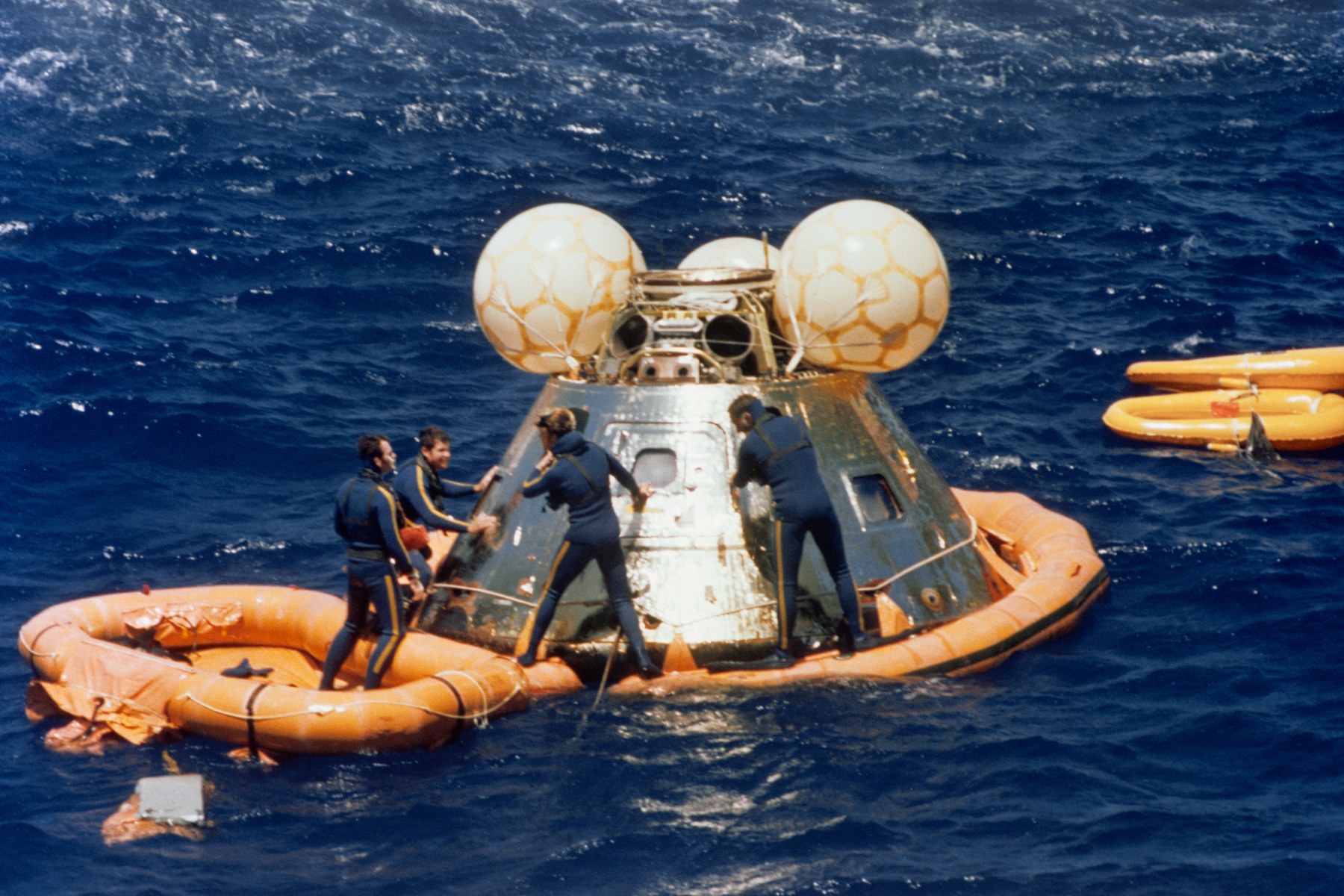
Rescue comes second. Under Article 2, if the crew land in a State’s territory, that State “shall immediately take all possible steps to rescue them and render them all necessary assistance”. The launching authority must cooperate if its help would make the rescue faster or more effective, but the operation stays “subject to the direction and control” of the territorial State. That is an important point of sovereignty: a launching State has no right to send its own recovery forces into another State’s territory without consent.
Article 3 covers landings on the high seas or in places outside any State’s jurisdiction. The obligation there is softer. Parties “which are in a position to do so shall, if necessary, extend assistance”.
Return comes last. Article 4 says that crew who land or are found in these circumstances “shall be safely and promptly returned to representatives of the launching authority”. The obligation is unconditional on its face. There is no exception for crew who wish to stay, and no reference to asylum or criminal jurisdiction. Whether a State could refuse to return a crew member who sought protection is debated in the literature; the text gives no help.
Who counts as an astronaut?
The Outer Space Treaty speaks of “astronauts”. The Rescue Agreement, apart from its title, speaks of the “personnel of a spacecraft”. Neither term is defined.
When the agreement was written, everyone on board was a professional crew member employed by a State. Today, people fly to orbit and on suborbital flights as paying customers. US law draws a clear line between them. Under 51 U.S.C. section 50902, “crew” means employees of a licensee or its contractors who perform activities relating to the flight, while a “space flight participant” is “an individual, who is not crew or a government astronaut, carried within a launch vehicle or reentry vehicle”.
Does the Rescue Agreement protect the space flight participant? The better view is that the duties to rescue and return should apply to everyone on board a spacecraft in distress. A rescue that saved the pilots and left the passengers would make no sense, and the agreement’s preamble says it is “prompted by sentiments of humanity”. But the drafting leaves room for argument, and the question has not been tested. It matters more as companies sell seats on orbital missions and plan private stations. Our piece on space tourism and the law covers how the United States regulates those passengers at home.
Space objects: Article 5 in practice
Article 5 is the part of the agreement that is used regularly, because objects fall to Earth far more often than crews land off course.
It works in five steps. A State that learns that a space object or its parts have “returned to Earth” in its territory, on the high seas or elsewhere outside national jurisdiction must notify the launching authority and the Secretary-General (Article 5(1)). If the object is in its territory, it must, at the launching authority’s request, “take such steps as it finds practicable to recover the object” (Article 5(2)). On request, objects found outside the launching authority’s territory “shall be returned to or held at the disposal of” its representatives, who must first supply identifying data on request (Article 5(3)). If the object may be “hazardous or deleterious”, the State can notify the launching authority, which must “immediately take effective steps” to remove the danger, under the direction and control of the State where it landed (Article 5(4)). Finally, the launching authority pays: recovery and return expenses “shall be borne by the launching authority” (Article 5(5)).
The notices show how this works. On 4 September 2013 the United States told the Secretary-General, “in accordance with article 5, paragraph 1”, that a piece of what appeared to be an Ariane launch vehicle fairing, about 4.2 by 4.0 metres and weighing about 100 kilograms, had washed ashore near Dry Tortugas National Park in Florida. It listed the identifying plate, said the National Park Service was holding the object, and confirmed it had notified France and invited it to identify the object. The note was circulated as UN document A/AC.105/1066.
A more recent example comes from the Caribbean. After Starship’s eighth test flight broke up on 6 March 2025, debris washed ashore on several Bahamian islands. In April 2025 the Bahamas sent notes verbales dated 1 and 3 April to the Secretary-General, each listed by UNOOSA as a notification under the Rescue Agreement concerning the recovery of space objects (A/AC.105/1357 and A/AC.105/1360). Bahamian officials also told the press that some of the debris found on other islands came from three other operators, and that the matter had been reported to the United Nations.
Two points stand out. Identification is the hard part, which is why the Registration Convention and the markings on hardware matter, as we explained in our Registration Convention explainer. And Article 5 deals only with recovery and return. If falling debris causes damage, the claim belongs under the Liability Convention, which imposes absolute liability for damage on the surface of the Earth. Our piece on who pays when satellites collide explains how that regime works.
The launching authority, not the State of registry
Article 6 defines the “launching authority” as “the State responsible for launching”, or an intergovernmental organisation responsible for launching if it has declared acceptance of the agreement and a majority of its members are parties to both the agreement and the Outer Space Treaty.
This is a different test from the Outer Space Treaty, which provides for return to the “State of registry”. It is also different from the Liability and Registration Conventions, which use the four-part “launching State” definition. Usually the answers coincide. When they do not, for instance where a satellite is registered by one State but launched under a contract procured by another, the agreement does not say how to choose. The agreement leaves it to the States concerned to settle through diplomatic channels, and the State that licensed the operator is the natural one to take the lead.
What the agreement does not cover
Four gaps are worth knowing.
The first is rescue in space. Articles 1 to 4 are written around landings on Earth: the obligations attach to crew who “land in territory under the jurisdiction” of a party, or who have “alighted on the high seas”. Article 1 and Article 3 also mention “any other place not under the jurisdiction of any State”, which some scholars read as covering outer space and the Moon. Others read it as limited to places on Earth such as Antarctica. The Outer Space Treaty supplies a separate rule for space: Article V says “the astronauts of one State Party shall render all possible assistance to the astronauts of other States Parties”. That is a duty on astronauts, not a duty on States to launch a rescue mission.
Practice has filled the gap with partnership arrangements rather than treaty law. When NASA decided in 2024 that Boeing’s Starliner would return without its crew, Butch Wilmore and Suni Williams stayed on the station and came home on SpaceX’s Crew-9 Dragon, which splashed down off Florida on 18 March 2025 after 286 days. That was handled within NASA’s own programme, not under the Rescue Agreement. The Artemis Accords go a step further in political terms: in Section 6 the signatories “commit to taking all reasonable efforts to render necessary assistance to personnel in outer space who are in distress, and acknowledge their obligations under the Rescue and Return Agreement.”
The second is cost of rescuing people. Article 5(5) puts the cost of recovering and returning objects on the launching authority. There is no equivalent for rescuing and returning crews. A State that mounts a large search and rescue operation for a foreign crew has no right under the agreement to be reimbursed.
The third is capability. The duty in Article 2 is to take “all possible steps”, and in Article 3 it applies only to parties “in a position to do so”. Neither creates an obligation to maintain rescue capability. That is reasonable on Earth, where navies and coastguards already exist. It means little in lunar orbit, where perhaps one or two States could help at all.
The fourth is time. The agreement asks for immediate notification and prompt return, but sets no deadlines and has no dispute mechanism. Like most of the UN space treaties, it works because States want reciprocity, not because of enforcement.
Why it still matters
The Rescue Agreement is rarely litigated and rarely in the news, but it carries two practical consequences that operators and governments should keep in mind.
For launch and reentry operators, Article 5 means that hardware landing abroad is a matter between governments. The operator cannot simply send a team to collect it. Its licensing State will deal with the State where the debris landed, and the operator should expect to fund recovery and return. Mission planning that puts stages or capsules down near other States’ territory or in busy waters should assume that a notification, a request for identification and a bill may follow.
For crewed missions, the agreement is the baseline legal assurance that a crew landing off course will be helped and sent home, whatever the politics between the States involved. That assurance has held since 1968, including through the Cold War, and it remains one of the more successful pieces of the space treaty system.
What I would watch
The first is debris notifications. As launch cadence rises and more stages and fairings are recovered or expended at sea, I expect more Article 5 notices to the Secretary-General, and more States in the Caribbean, Pacific and Indian Ocean using the procedure to press operators and launching States for recovery and cleanup.
The second is commercial stations. When private stations replace the ISS, rescue and crew return will depend on contracts between operators and their customers, backed by licence conditions. Whether those arrangements refer to the Rescue Agreement, and whether passengers are treated as “personnel”, will be worth reading closely.
The third is the Moon. Artemis and China’s lunar programme will put crews far from any State able to help quickly. The Artemis Accords’ Section 6 commitment is a start, but a real lunar rescue framework will need agreed procedures, compatible hardware and someone willing to pay.
The fourth is new parties. The agreement sits at 100 parties, behind the Outer Space Treaty. Each new space nation that procures launches or sends astronauts abroad has a reason to join, if only to be sure its crews and hardware will be returned.
Questions people actually ask
What is the Rescue Agreement?
The Rescue Agreement, formally the Agreement on the Rescue of Astronauts, the Return of Astronauts and the Return of Objects Launched into Outer Space, is a 1968 UN space treaty. It requires States to notify, rescue and promptly return spacecraft crews who land in their territory or on the high seas, and to notify and, on request, return space objects that fall to Earth. It entered into force on 3 December 1968.
How many countries have ratified the Rescue Agreement?
UNOOSA’s status table as at 1 January 2025 records 100 States Parties and 23 signatories that have not ratified. The European Space Agency, EUMETSAT and Intersputnik have also declared acceptance of its rights and obligations. The depositaries are the United Kingdom, the United States and the Russian Federation.
What happens if rocket debris lands in another country?
Under Article 5 of the Rescue Agreement, the State where it lands must notify the launching authority and the UN Secretary-General. On request, it must take practicable steps to recover the object and return it, or hold it at the launching authority’s disposal. The launching authority pays the costs of recovery and return. Claims for damage fall under the separate Liability Convention.
Does the Rescue Agreement apply to space tourists?
The agreement protects the “personnel of a spacecraft” and does not define the term or mention passengers. US law distinguishes crew from space flight participants, but the better view is that the duties to rescue and return apply to everyone on board a spacecraft in distress. The question has not been tested.
Does the Rescue Agreement require States to rescue astronauts in orbit?
Not clearly. Its rescue and return duties are written mainly around landings on Earth. Article V of the Outer Space Treaty requires astronauts of one State to give all possible assistance to astronauts of others in space, and Section 6 of the Artemis Accords commits signatories to reasonable efforts to help personnel in distress in outer space.
Who pays for rescuing astronauts under the Rescue Agreement?
The agreement does not say. Article 5(5) makes the launching authority bear the cost of recovering and returning space objects, but there is no matching provision for the cost of searching for, rescuing or returning crews. Those costs fall where they land unless the States agree otherwise.

Anuj KumarEditor-in-Chief
Anuj Kumar is the founder of Legal Desire Media and publishes Fashion Law Journal and Space Law Journal.
Space Law Journal is a joint initiative of Legal Desire Media and Odyogeek. Spotted something we got wrong, or want to respond? Write to space@legaldesire.com.