Where Does Space Begin? The Kármán Line, the 80 km Debate and Why the Law Has No Boundary
Where does space begin? The Kármán line, the 80 km debate, the national laws that pick 100 km, and why international law still sets no boundary in the sky.
Where does space begin? It is one of the most searched questions in space law, and the legal answer is short: nobody has agreed. There is a popular number, 100 kilometres, and a serious argument for a lower one, 80 kilometres. Some countries have written one or the other into their own law. But no treaty fixes a boundary, and the main spacefaring State has said for decades that it does not want one.
That would be a curiosity if the boundary did not matter. It does. The law of airspace and the law of outer space rest on opposite principles, one of national sovereignty and one of freedom from it. Where one ends and the other begins affects whose permission a flight needs, which liability rules apply, who counts as an astronaut and, as a State Department proposal this month shows, how export controls are drafted.
Two legal regimes with no line between them
Airspace belongs to States. Article 1 of the 1944 Chicago Convention on International Civil Aviation records that every State “has complete and exclusive sovereignty over the airspace above its territory”. Aircraft of other States need permission to enter it.
Outer space is the opposite. Article I of the Outer Space Treaty makes it “free for exploration and use by all States”, and Article II says it “is not subject to national appropriation by claim of sovereignty, by means of use or occupation, or by any other means”. Our Outer Space Treaty explainer covers both articles in more detail.
So a State’s sovereignty runs upwards until it meets outer space, and then stops. Neither treaty says where that happens. The Chicago Convention does not define the upper limit of airspace, and the Outer Space Treaty does not define the lower limit of outer space. The other UN space treaties follow the same pattern. The Liability Convention, for example, distinguishes damage “on the surface of the earth” or to aircraft in flight, where liability is absolute, from damage “elsewhere”, where it depends on fault, as we explained in our piece on space debris liability. It never mentions altitude.
The treaties often avoid the problem by using function rather than height. The Registration Convention applies when a space object “is launched into earth orbit or beyond”. A suborbital flight that goes up and comes down without completing an orbit is not caught, wherever its peak happens to be.
Where the 100 km figure comes from
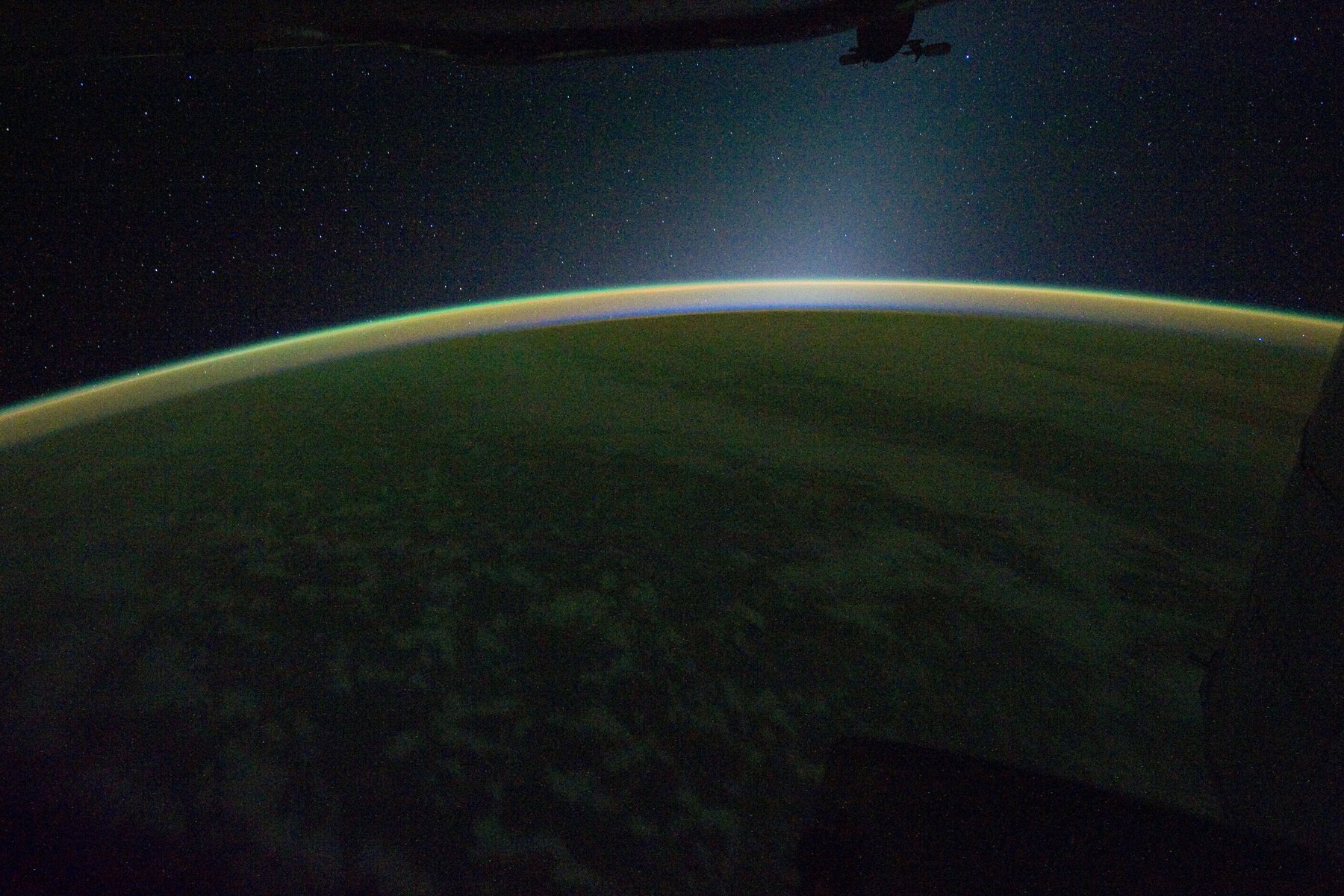
The Kármán line is named after the aerospace engineer Theodore von Kármán. It is a round number rather than a physical edge. The atmosphere thins gradually and has no surface.
Its main institutional home is the Fédération Aéronautique Internationale, the world body for air sports and aeronautical records, which uses 100 km as the boundary for astronautics records. In a statement of 30 November 2018, the FAI noted that it and many other organisations use 100 km, but said that “Recently published analyses present a compelling scientific case for reduction in this altitude from 100km to 80km.” It proposed an international workshop with the International Astronautical Federation to consider the question.
The analysis it had in mind was largely the work of Jonathan McDowell of the Harvard-Smithsonian Center for Astrophysics. In “The Edge of Space: Revisiting the Karman Line”, published in Acta Astronautica in 2018, he looked at historical, physical and technological evidence, including the trajectories of real satellites, and proposed “80 kilometers as a more appropriate boundary than the currently popular 100 km Von Kármán line.”
None of this is law. The FAI is a sporting federation, and an academic paper binds nobody. But both explain why two numbers keep appearing in legal debates.
The US approach: 50 miles for wings, no line in law
The United States has used the lower figure for one practical purpose. Under its Commercial Space Astronaut Wings programme, the FAA recognised crew on licensed flights who reached 50 statute miles, about 80 km. When it ended the programme on 10 December 2021, it said that from 2022 it would instead list on its website anyone on an FAA licensed or permitted launch who “reaches 50 statute miles above the surface of the Earth”.
That is recognition, not regulation. US licensing law does not depend on crossing any altitude. A launch needs an FAA licence because it is a launch, not because it reaches a particular height.
At the UN, the US position is firm. In a statement to the Legal Subcommittee on 6 May 2025, the US representative said that “there is no need to seek a legal definition or delimitation for outer space”, that the current framework “has presented no practical difficulties”, and that any attempt to define it “would be an unnecessary theoretical exercise that could unintentionally complicate existing activities”. The statement added that definitions adopted by US states or federal agencies for their own purposes “do not relate to, and are not evidence of, the existence of a definition of outer space under international law.”
That last point is worth noting. The United States is protecting itself against the argument that its own internal definitions, such as the FAA’s 50 miles, amount to State practice supporting a customary boundary.
Countries that have picked a number
Some States have put an altitude into their national space laws, mainly to fix the scope of their licensing regimes.
Australia is the clearest example. Section 8 of the Space (Launches and Returns) Act 2018 defines a space object as an object that is to go into or come back from “an area beyond the distance of 100 km above mean sea level”, and defines launching and returning by reference to the same line. Rockets that stay below 100 km are treated as “high power rockets” under a separate permit regime.
Denmark’s Outer Space Act 2016 defines outer space as “space above the altitude of 100 km above sea level”. In a note to UNOOSA dated 14 June 2018, the Danish ministry explained that the purpose was “to clarify the scope of the Act” and “provide certainty to industry”, while stating that “No rule of conventional or customary international law defines where air space ends and outer space begins” and that the definition does not “in any way prejudge a Danish position” on the meaning of outer space in international law.
That pattern is typical. National definitions are written for domestic certainty and expressly disclaim any effect on the international question.
Sixty years at the UN
As our plain English guide to space law notes, the boundary is one of the oldest open questions in the field. The definition and delimitation of outer space is a standing item on the agenda of the Legal Subcommittee of the UN Committee on the Peaceful Uses of Outer Space. At the subcommittee’s sixty-fifth session in Vienna in April 2026, Brazil and Mexico organised a side event titled “Perspectives on the definition and delimitation of outer space: 60 years of the topic as an agenda item”. The item is paired with the character and use of the geostationary orbit.
The draft report of that session records statements on the item by, among others, Brazil, Canada, China, France, the Russian Federation, South Africa and the United States, and a presentation by Ukraine on the legal definition of outer space and celestial bodies. It also recalls the subcommittee’s 2023 agreement that new documentation on the item would be prepared only every two years. That is a fair measure of momentum.
The debate is often described as one between “spatialists”, who want a boundary at a fixed height, and “functionalists”, who would apply space law to space activities wherever they take place. Neither side has won, and the practical consensus has been to live without an answer.
Where the gap actually bites
Living without a line works most of the time because orbital spaceflight is easy to identify. Satellites cannot stay in orbit in the denser atmosphere, and nobody doubts that the International Space Station is in outer space. The difficulties come at the margins.
The first is suborbital flight. A vehicle that climbs past 80 or 100 km and comes back down may pass over another State’s territory on the way up or down. Whether that State’s consent is needed under the law of airspace, and whether the vehicle is an aircraft or a space object while it does so, has no settled answer. Suborbital tourism flights so far have launched and landed within the United States, which avoids the question. Our piece on space tourism explains how those flights are licensed.
The second is the status of people on board. Whether someone is an “astronaut” for the purposes of Article V of the Outer Space Treaty and the Rescue Agreement may turn on whether they went to space. The FAA list and the FAI records give working answers, but not legal ones.
The third is drafting. Domestic rules that use the phrase “into space” inherit the uncertainty. That is exactly the point the State Department made on 1 October 2026 in its proposed revision of the ITAR (91 FR 62361). Under the current rule in section 120.54(a)(1), launching a spacecraft or other article “into space” is not an export. The proposal would change that to launching it “into or beyond orbit”, because “the term ‘into space’ is not defined”. The department explains that the change is meant to give “a clear criterion” and is consistent with the current scope, since launches that do not reach orbit and return directly to the United States are already covered by a separate provision. Comments are due by 30 November 2026.
The ITAR change is a small one, but it shows how regulators handle the problem. Rather than choose an altitude, they reach for a functional test, orbit, that everyone can apply.
What I would watch
The first is the ITAR rulemaking. If the “into or beyond orbit” language is adopted, it becomes another example of US regulation using orbit, not altitude, as the trigger, which fits the US position at the UN.
The second is the 2027 session of the Legal Subcommittee, when the next round of biennial documentation on delimitation is due. Any move beyond restating positions would be news.
The third is suborbital point to point transport. If companies start flying passengers or cargo on suborbital trajectories between countries, the question of whose airspace they cross, and under what regime, will stop being academic. I expect it to be settled, if at all, by bilateral agreements and licence conditions rather than by a global boundary.
The fourth is national laws. Each new space law has to decide whether to name a figure. Most that do will follow Australia and Denmark in choosing 100 km for domestic purposes while reserving their position on international law. That is the likely future of the Kármán line: a convenient number in national statutes, not a rule of international law.
Questions people actually ask
Where does space begin legally?
There is no legally agreed boundary. The Outer Space Treaty, the Chicago Convention and the other UN space treaties do not define where airspace ends and outer space begins. Some States set a figure in their own laws for domestic purposes, usually 100 km, but those definitions do not bind other States and do not create a rule of international law.
What is the Kármán line?
The Kármán line is a boundary at 100 km above sea level, named after the engineer Theodore von Kármán. The Fédération Aéronautique Internationale uses it for astronautics records, and Australia and Denmark use 100 km in their national space laws. It is a convention, not a physical edge or a treaty rule.
Is the edge of space 80 km or 100 km?
Both figures are in use. The FAI uses 100 km, but said in November 2018 that recent analyses made “a compelling scientific case” for 80 km, citing work such as Jonathan McDowell’s 2018 paper in Acta Astronautica. The FAA recognised commercial astronauts who reached 50 statute miles, about 80 km. No figure is legally binding internationally.
Why does the United States oppose defining outer space?
In a statement to the UN Legal Subcommittee on 6 May 2025, the United States said there is “no need” for a legal definition, that the current framework has caused no practical difficulties, and that a definition could complicate existing activities and prove irrelevant to future technology. It also said US domestic definitions are not evidence of an international one.
Which countries define outer space in their laws?
Australia’s Space (Launches and Returns) Act 2018 defines space objects and launches by reference to an area beyond 100 km above mean sea level. Denmark’s Outer Space Act 2016 defines outer space as the space above 100 km. Denmark told UNOOSA in 2018 that its definition is for domestic certainty and does not prejudge its position under international law.
Does the boundary of space matter in practice?
Mostly at the margins. It can affect whether suborbital flights crossing foreign territory need airspace permission, who counts as an astronaut, and how domestic rules are drafted. In October 2026 the US State Department proposed replacing the undefined phrase “into space” in an ITAR provision with launches “into or beyond orbit”.

Anuj KumarEditor-in-Chief
Anuj Kumar is the founder of Legal Desire Media and publishes Fashion Law Journal and Space Law Journal.
Space Law Journal is a joint initiative of Legal Desire Media and Odyogeek. Spotted something we got wrong, or want to respond? Write to space@legaldesire.com.