Inventions Made in Space: The Unsettled Law of Orbital Innovation
Inventions made in space raise unsettled patent questions: registry states, ISS modules, NASA contracts, AI inventors and orbital data centres.
Commercial space stations are poised to replace the ageing International Space Station within the next decade, opening orbital platforms to researchers, manufacturers, and entrepreneurs from around the world. This transition raises questions that were once purely theoretical but now demand practical answers: What happens when an invention is conceived or reduced to practice in space? Who owns it, and which nation’s patent law governs? The legal framework remains unsettled, yet the stakes are growing rapidly as in-space manufacturing moves from experiment to commercial reality.
Which nation’s patent law applies in orbit?
Under 35 U.S.C. § 105(a), an invention “made” on a space object under U.S. jurisdiction or control is treated as made within the United States, meaning U.S. patent law governs questions of patentability and ownership. For innovations developed on U.S.-registered spacecraft or U.S. modules of the International Space Station, the legal framework is relatively clear: they are treated as if they occurred on U.S. soil. But as private stations multiply and international collaboration expands, the gaps in this framework are becoming increasingly consequential.
The ISS: clear modules, unclear gaps
On the ISS specifically, the Intergovernmental Agreement (1998) extends each participating nation’s jurisdiction to its own segment or module. An invention made in the U.S. module (or on U.S.-registered ISS elements) is subject to U.S. patent law, while an invention made in a European Space Agency module falls under the applicable European national law, and an invention in the Japanese Experiment Module is subject to Japanese law. But the ISS framework also exposes gaps. What about shared areas like nodes, airlocks, or common spaces not exclusively assigned to one nation? What about an invention conceived in one module and reduced to practice in another? Patent law traditionally requires identifying where conception and reduction to practice occur. When these acts happen in different jurisdictional zones floating in orbit, the analysis becomes truly novel and presently unresolved.
NASA contractors and the coming commercial stations
For NASA contractors, additional ownership considerations apply. Under 51 U.S.C. § 20135(b), title to an invention may vest in the United States if it is made in performance of a NASA contract. The Bayh-Dole Act (35 U.S.C. §§ 200-212) provides small businesses and nonprofit organisations the right to elect title to inventions made under federal funding agreements, including those conceived or first reduced to practice in space, but subject to the government retaining a nonexclusive licence and march-in rights. For the coming generation of commercial space stations, the regulatory framework is less settled. Companies developing platforms that will host researchers, manufacturers, and innovators from around the world face a critical question: under which nation’s registry will these stations operate? If registered in the United States, Section 105(a) provides a clear jurisdictional hook. If registered elsewhere, or if portions are registered to different states, the analysis becomes far more complex.
Consider this scenario: an employee of a U.S. company works aboard a commercial space station registered to a foreign country. Section 105(a) would not apply because the station is not under U.S. jurisdiction or control. The foreign state’s law would govern, unless a bilateral agreement exists under Section 105(b). This could mean that innovations developed by U.S. nationals on foreign-registered platforms fall outside U.S. patent law entirely.
When an AI makes the invention in orbit
The emergence of artificial intelligence adds another layer of complexity to these already difficult questions. Under current U.S. patent law, only natural persons can be inventors. The USPTO and federal courts have consistently held that AI systems cannot be named as inventors on patent applications, a position affirmed by the Federal Circuit in Thaler v. Vidal (2022), which upheld the USPTO’s rejection of applications listing an AI system called DABUS as the sole inventor. This terrestrial rule carries significant implications for space-based innovation. Consider an AI system operating autonomously on a spacecraft or space station that identifies a novel solution to an engineering problem, optimises a manufacturing process, or discovers a new material composition through experimentation. If no human conceived of the invention, if the AI generated it independently while operating in orbit, U.S. patent law may offer no path to protection at all. The invention would be unpatentable not because it lacks novelty or nonobviousness, but because it lacks a qualifying human inventor. Space companies deploying sophisticated AI systems in orbit must therefore structure their operations to ensure meaningful human involvement in the inventive process or accept that certain AI-generated innovations will fall into the public domain.
Where is an orbital data centre “used”?
The growing interest in space-based data centres introduces yet another dimension to these jurisdictional puzzles. Several companies are exploring the deployment of computing infrastructure in orbit, attracted by the potential for enhanced security, unlimited cooling via radiative heat dissipation, and freedom from terrestrial regulatory constraints. If data centres operate on space objects, the question arises: where is a computational process “used” for purposes of patent infringement? If a patented algorithm runs on servers aboard a spacecraft registered in a flag-of-convenience jurisdiction, Section 105(a) may not reach the infringement. The data processing occurs in orbit, beyond the reach of terrestrial patent enforcement, unless the spacecraft is U.S.-registered or covered by a bilateral agreement under Section 105(b). This creates potential for regulatory arbitrage, as companies could theoretically locate computing operations in space specifically to avoid patent liability for processes that would infringe if performed on Earth. For patent owners, this scenario reinforces the importance of claiming terrestrial acts: the upload of data, the download of results, or the ground-based systems that interface with orbital computing resources. For companies considering space-based data centres, the registration decision takes on heightened importance, as it will determine which patent regimes reach their orbital operations.
What space companies should do now
Space companies planning orbital operations should take several proactive steps. Employment agreements should include robust invention-assignment clauses that explicitly cover work performed in space, regardless of the jurisdictional zone, specifying that the employer owns all inventions conceived or reduced to practice during the employee’s space-based work. These agreements should also specify choice of law and choice of forum for IP disputes. Do not assume that terrestrial defaults will apply in the space context. Companies should carefully consider the registry state of their space platform when planning IP strategy, recognising that the registration decision has downstream consequences for every invention made aboard that platform.
For operations on the ISS, ensure personnel understand which module’s jurisdiction applies to their work location and document where inventive activities occur. File provisional patent applications promptly when inventions are conceived in orbit. Do not wait for the inventor’s return to Earth. The first-to-file system rewards speed, and delay creates risks of intervening prior art or competing filings. For AI-assisted research, establish protocols that ensure human scientists remain substantively involved in the inventive process, so that a natural person can truthfully be named as an inventor on any resulting patent application.
Finally, monitor developments in the Artemis Accords and future bilateral agreements that may expand Section 105(b) coverage to additional nations’ registries, as well as evolving law on AI inventorship that may eventually recognise machine contributions to the inventive process. The legal landscape is evolving on multiple fronts, and companies that plan ahead by structuring their registrations, employment agreements, AI protocols, and filing strategies with these uncertainties in mind will be best positioned to capture and protect the innovations born in humanity’s expanding presence beyond Earth.
About the authors


Questions people actually ask
Which patent law applies to an invention made in space?
It depends on the space object. Under 35 U.S.C. § 105(a), an invention made on a space object under US jurisdiction or control is treated as made within the United States. On the ISS, jurisdiction follows each partner’s module. On a foreign-registered station, the foreign state’s law would govern unless a bilateral agreement exists under Section 105(b).
Who owns an invention made under a NASA contract in space?
Under 51 U.S.C. § 20135(b), title to an invention may vest in the United States if it is made in performance of a NASA contract. The Bayh-Dole Act gives small businesses and nonprofit organisations the right to elect title to inventions made under federal funding agreements, subject to a government licence and march-in rights.
Can an AI be named as an inventor on a space invention?
No. Under current US patent law only natural persons can be inventors, a position the Federal Circuit affirmed in Thaler v. Vidal in 2022. If an AI system generates an invention in orbit with no human conception, US patent law may offer no path to protection.
Does patent law reach a data centre in orbit?
Possibly not. If a patented algorithm runs on servers aboard a spacecraft registered outside the US, Section 105(a) may not reach the infringement unless the spacecraft is US-registered or covered by a bilateral agreement under Section 105(b). Patent owners can respond by claiming terrestrial acts such as uploading data, downloading results and ground systems.
What should space companies do to protect inventions made in orbit?
Use invention-assignment clauses that expressly cover work in space, specify choice of law and forum, weigh the registry state when planning IP strategy, document where inventive activity occurs, file provisional applications promptly and keep human scientists substantively involved in AI-assisted research.
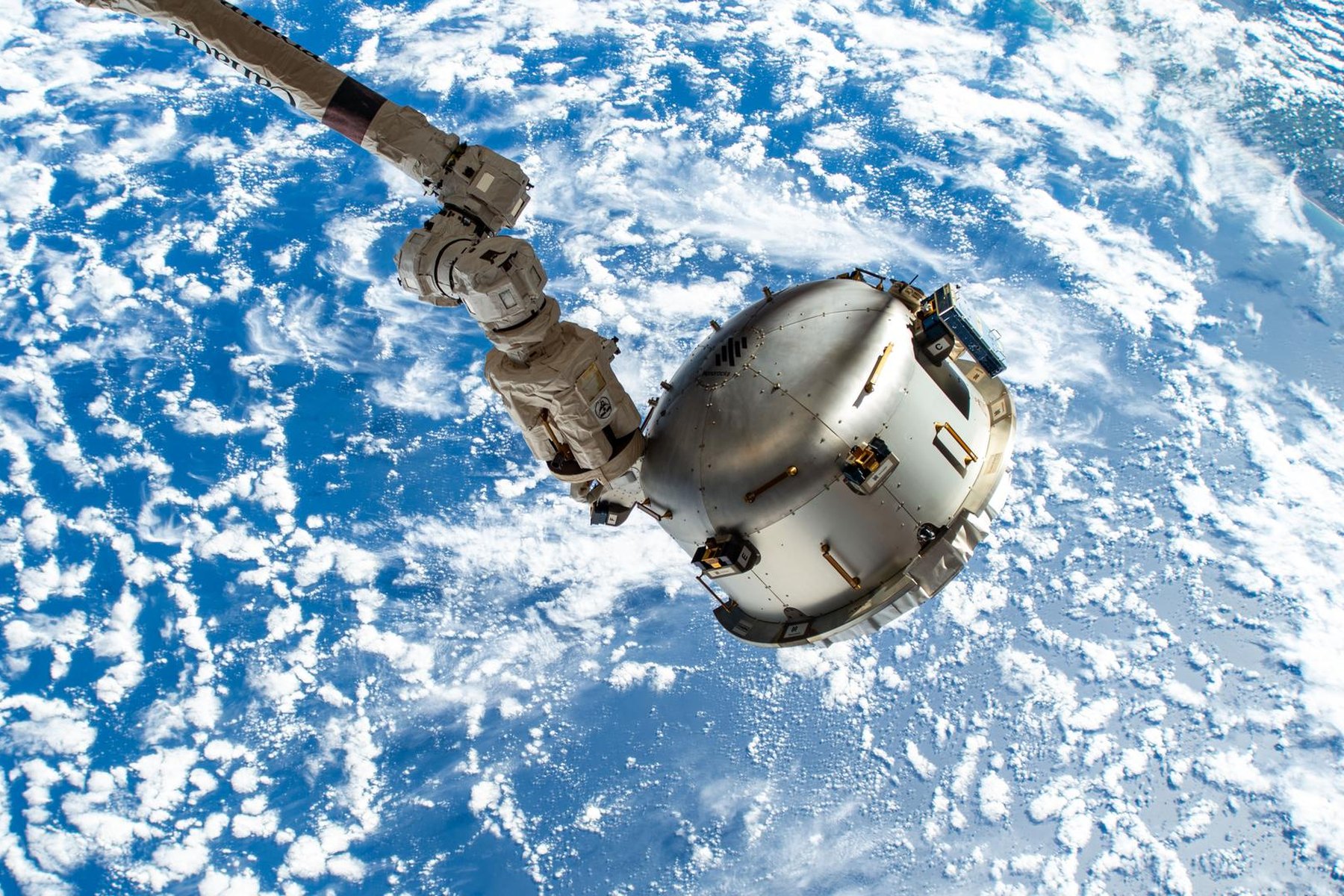
Featured image: The NanoRacks Bishop airlock held by the Canadarm2 robotic arm on the International Space Station, 21 February 2024. Photo: NASA, public domain.

Eric Sophir and Gary SolomonPartners, Foley & Lardner LLP
Eric Sophir and Gary Solomon are intellectual property partners with Foley & Lardner LLP.
Space Law Journal is a joint initiative of Legal Desire Media and Odyogeek. Spotted something we got wrong, or want to respond? Write to space@legaldesire.com.