LEO vs MEO vs GEO: How a Satellite’s Orbit Decides the Rules It Must Follow
LEO vs MEO vs GEO explained: altitudes, uses and the rules that change with orbit, from ITU orbital slots and FCC licensing to graveyard disposal.
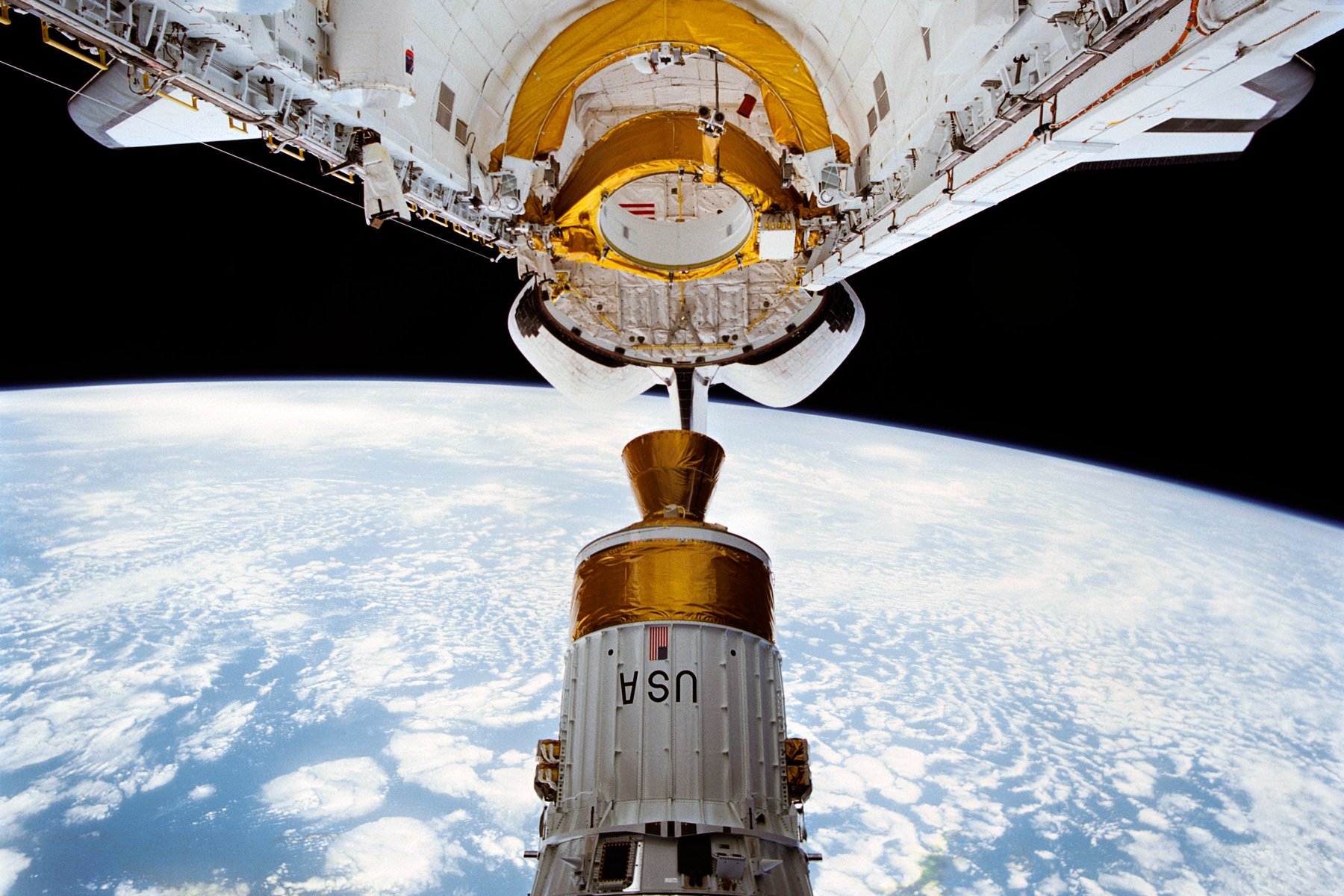
On 2 August 1991, six hours after launch, the crew of Space Shuttle Atlantis released the Tracking and Data Relay Satellite TDRS-E from the payload bay, as in the photograph above. It was released in low Earth orbit, attached to its upper stage, but it was not going to stay there. NASA’s caption says it was to be placed in geosynchronous orbit, where it would replace an earlier relay satellite, TDRS-3, at 174 degrees West.
That journey crosses most of the regulatory map of Earth orbit. The same spacecraft, in the same mission, passes through regions with different spectrum rules, different debris rules and different collision warning thresholds. This explainer sets out the main orbits, LEO, MEO, GEO and the elliptical ones, and the legal rules that attach to each.
The main orbits at a glance
The law has no single definition of these orbits, but regulators and agencies use consistent boundaries. The figures below come from ESA’s guide to types of orbits, the US government’s GPS space segment page, the FCC’s rules and the debris guidelines of the Inter-Agency Space Debris Coordination Committee (IADC).
| Orbit | Altitude | Typical uses | Rules that attach |
|---|---|---|---|
| Low Earth orbit (LEO) | Up to 2,000 km; satellites generally do not fly below about 180 km | Earth observation, the International Space Station, broadband constellations | FCC five-year re-entry rule, processing rounds, IADC protected Region A |
| Sun-synchronous orbit (SSO) | Usually 600 to 800 km, a type of polar LEO | Imaging that needs the same local time each pass | As for LEO |
| Medium Earth orbit (MEO) | Between LEO and GEO; GPS flies at about 20,200 km | Navigation (GPS, Galileo) | Disposal judged case by case; deep-space collision criteria |
| Geostationary orbit (GEO) | 35,786 km above the equator | Telecommunications, weather monitoring | ITU orbital positions, FCC first-come queue, graveyard orbit, IADC protected Region B |
| Highly elliptical orbit (HEO) | Varies widely between a low perigee and a high apogee | Observing Earth or space from high altitude for long periods | Disposal judged case by case; deep-space collision criteria |
A satellite in LEO travels at about 7.8 km per second and circles the Earth in about 90 minutes. One in GEO completes an orbit in 23 hours 56 minutes and 4 seconds, a sidereal day, which is why it appears fixed over one spot. GPS satellites in MEO, the GPS site says, circle the Earth twice a day.
GEO: a limited natural resource
Geostationary orbit is the one orbit named expressly in the ITU’s founding treaty. Article 44 of the ITU Constitution requires member states to bear in mind that “radio frequencies and any associated orbits, including the geostationary-satellite orbit, are limited natural resources” that “must be used rationally, efficiently and economically”, so that countries “may have equitable access to those orbits and frequencies”.
The reason is geometry. There is one ring, and satellites using the same frequencies have to be spaced along it to avoid interfering with each other. In practice, a GEO operator needs an orbital position coordinated through the ITU, as our explainer on ITU spectrum and orbital slots describes. The ring’s special status also explains the 1976 Bogotá Declaration, in which equatorial states claimed the segments above their territory, a claim that never gained acceptance because of the Outer Space Treaty’s ban on national appropriation. Our piece on the legal status of geostationary orbit tells that story.
US licensing reflects the same logic. Under 47 CFR 25.158, FCC applications for “GSO-like” satellite operation are “placed in a queue and considered in the order that they are filed”. The FCC also asks GEO applicants, under 25.114(d)(14)(iv)(B), whether any other satellite’s station-keeping volume at the requested location “might overlap or touch” theirs, and how they will prevent a collision.
GEO at end of life: the graveyard orbit
Old GEO satellites are not brought down. They are moved up. The IADC guidelines define a protected “Geosynchronous Region” from 200 km below to 200 km above geostationary altitude, and between 15 degrees north and south of the equator. Guideline 7 of the UN Space Debris Mitigation Guidelines, covered in our debris guidelines explainer, asks operators to leave spent objects “in an orbit above the GEO region such that they will not interfere with, or return to, the GEO region.”
The FCC has turned that into a formula. Under 47 CFR 25.283(a), a GEO satellite must be moved at the end of its useful life, barring catastrophic failure, to an orbit with a perigee of at least 36,021 km plus 1,000 times the product of its solar radiation pressure coefficient and its area to mass ratio. The 36,021 km figure is geostationary altitude plus 235 km. The IADC guidelines explain that 235 km is the 200 km upper edge of the protected region plus 35 km for the “maximum descent of a re-orbited spacecraft due to luni-solar & geopotential perturbations.” The requirement does not apply to satellites launched before 18 March 2002.
LEO: crowded, and on a five-year clock
Low Earth orbit is the other protected region. The IADC defines Region A as the space from the Earth’s surface “up to an altitude (Z) of 2,000 km”, and the FCC uses the same boundary, referring to “the low-Earth orbit region below 2,000 km altitude.” Guideline 6 of the UN guidelines asks for spent objects in LEO to be “removed from orbit in a controlled fashion” or, if that is not possible, placed in orbits “that avoid their long-term presence in the LEO region.”
The FCC’s rule is stricter than the 25-year benchmark that the IADC guidelines describe as “reasonable and appropriate”. Under 47 CFR 25.283(e), a satellite ending its mission in or passing through LEO and relying on uncontrolled re-entry must be disposed of “as soon as practicable” and “no later than five years after the end of the mission.” Applicants must show that each satellite’s disposal has a probability of success of at least 0.9, with a goal of 0.99 for large systems. Our explainer on the FCC five-year deorbit rule covers how it came about.
Licensing in LEO also works differently from GEO. Non-geostationary systems are handled under 47 CFR 25.157 through processing rounds. A “lead application” is put on public notice, which sets a cut-off date for competing applications. If the band cannot accommodate every qualified applicant, the available spectrum “will be divided equally among the licensees” in the round, subject to exceptions. So where GEO is a queue, LEO is closer to a shared table.
There are also orbit-specific safety disclosures. A non-geostationary applicant must limit the probability of collision with objects 10 cm or larger to less than 1 in 1,000 over each satellite’s lifetime and, if its satellites will pass through the orbits of “any inhabitable spacecraft, including the International Space Station”, describe how it will avoid posing operational constraints on them.
Newsletter
Get Space Law Insider every Monday
One short email a week with the space law news and analysis worth your time. Free, and you can leave any time.
When LEO and GEO share spectrum
The most commercially important difference between orbits is in spectrum. Non-geostationary systems often use the same frequency bands as geostationary networks, and the international rules have long protected GEO.
The FCC’s version is 47 CFR 25.289: “an NGSO system licensee must not cause unacceptable interference to, or claim protection from, a GSO FSS or GSO BSS network.” An operator complying with the equivalent power flux-density (EPFD) limits in Article 22 of the ITU Radio Regulations “will be considered as having fulfilled this obligation”. The FCC changed parts of this framework in 2026, and our report on the FCC’s EPFD changes and their effective date explains where they stand.
The practical result is that a broadband constellation in LEO designs its power levels around satellites 35,786 km away that it will never come near physically.
MEO and elliptical orbits: the regulatory middle
MEO and highly elliptical orbits fall outside both protected regions. The IADC guidelines name only Region A and Region B, and the FCC’s disposal rules have specific provisions for GEO and for orbits in or passing through LEO, but not for MEO as such.
For satellites that fit neither category, 47 CFR 25.114(d)(14)(vii)(C) requires the applicant to say “whether disposal will involve use of a storage orbit or long-term atmospheric re-entry” and to give its rationale, and the FCC assesses successful disposal “on a case-by-case basis.” That is a disclosure rule, not a fixed standard.
Collision warnings also follow the orbit. The US Space Force’s Spaceflight Safety Handbook treats geosynchronous, highly elliptical and medium Earth orbits as “deep space” and all LEO regimes as “near earth”. Emergency notifications in deep space go out when a predicted approach within three days is 5 km or less. In LEO the trigger is a miss distance of 1 km or less combined with a probability of collision above a set threshold.
Moving between orbits
Most GEO satellites start, like TDRS-E, in a lower orbit. ESA describes transfer orbits as “a special kind of orbit used to get from one orbit to another”, and the IADC defines a geostationary transfer orbit as one that typically has its perigee within the LEO region and its apogee near or above GEO.
That matters legally because rules attach to orbits passed through as well as orbits occupied. The FCC’s LEO disposal rule applies to satellites ending their mission “in or passing through” LEO, so upper stages and spacecraft left in transfer orbits count. NASA’s collision avoidance best practices handbook also recommends that “transiting spacecraft should yield way to on-station spacecraft”, a convention rather than a rule, but one that shapes how operators plan orbit raising through busy LEO shells.
What I would watch
The first is the FCC’s rewrite of its satellite rules. Its Space Modernization for the 21st Century proposals were published in the Federal Register on 26 October 2026, and any change to the GSO queue, the NGSO processing rounds or the disposal rules will change the table above.
The second is MEO. The case-by-case disposal approach was not written with large numbers of satellites in mind. If more operators put constellations in medium Earth orbit, I would expect pressure for a clearer standard.
The third is the GEO graveyard. The 235 km margin keeps dead satellites out of the protected ring, but it does not remove them. As servicing and life extension missions grow, the question of who may touch, move or remove a satellite in the graveyard will need answers that the current rules do not give.
The orbit is the first fact a space lawyer should ask about a mission. Much of the answer to “which rules apply” follows from it.
Questions people actually ask
What is the difference between LEO, MEO and GEO?
LEO (low Earth orbit) extends up to 2,000 km altitude, MEO (medium Earth orbit) lies between LEO and geostationary orbit, and GEO (geostationary orbit) is a circular orbit 35,786 km above the equator where a satellite takes one sidereal day to orbit and appears stationary over one spot.
What altitude is low Earth orbit?
LEO is generally taken to be below 2,000 km. The IADC debris guidelines define the protected LEO region as extending from the Earth’s surface to 2,000 km, and the FCC uses the same boundary. ESA notes that satellites generally do not fly below about 180 km because of atmospheric drag.
Why is geostationary orbit treated differently in law?
Because it is a single ring that satellites on the same frequencies must share. Article 44 of the ITU Constitution calls the geostationary-satellite orbit a limited natural resource to be used rationally, efficiently and economically, with equitable access for all countries. GEO operators need coordinated orbital positions through the ITU.
What happens to geostationary satellites at end of life?
They are moved to a graveyard orbit above the geostationary ring. FCC rule 47 CFR 25.283(a) requires a perigee of at least 36,021 km plus 1,000 times the solar radiation pressure coefficient times the area to mass ratio, which is 235 km above GEO plus a margin. It applies to satellites launched after 18 March 2002.
What is the five-year rule for LEO satellites?
Under 47 CFR 25.283(e), FCC-licensed satellites ending their mission in or passing through LEO and relying on uncontrolled re-entry must be disposed of as soon as practicable and no later than five years after the end of the mission.
Do NGSO satellites have to protect GEO satellites?
Yes, in shared bands. Under 47 CFR 25.289 an NGSO licensee must not cause unacceptable interference to, or claim protection from, geostationary FSS or BSS networks. Compliance with the EPFD limits in Article 22 of the ITU Radio Regulations is treated as meeting that obligation.
Space Law Insider
Read the week in space law in five minutes
Every Monday we send one email with the new regulations, filings, cases and explainers published on Space Law Journal. Join practitioners, students and policy people who read it.

Anuj KumarEditor-in-Chief
Anuj Kumar is the founder of Legal Desire Media and publishes Fashion Law Journal and Space Law Journal.
Space Law Journal is a joint initiative of Legal Desire Media and Odyogeek. Spotted something we got wrong, or want to respond? Write to space@legaldesire.com.