Is There a Law on Satellite Brightness? Starlink, Astronomers and the Rules on Dark Skies
Is there a law on satellite brightness? The magnitude 7 benchmark, France's constellation rule, FCC conditions on Starlink and UN dark and quiet skies talks.
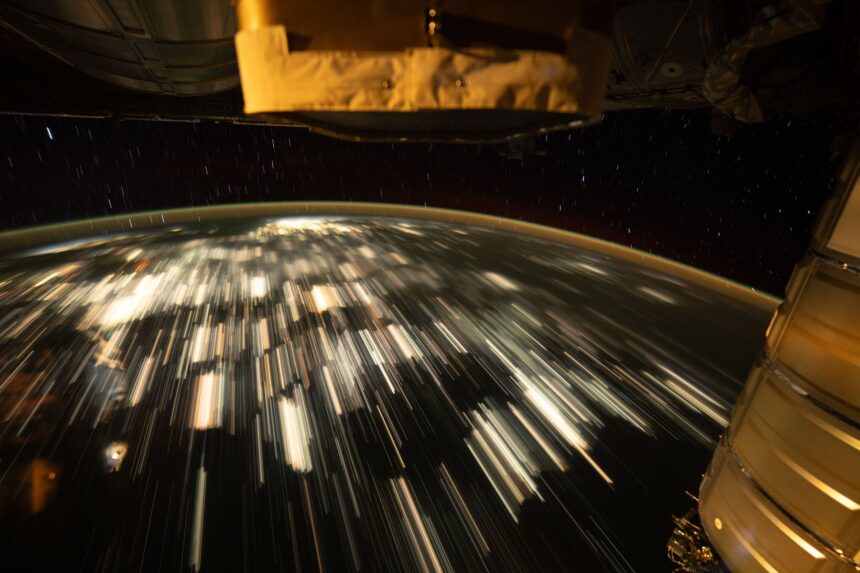
Anyone who looks up on a clear night has probably seen a satellite. Astronomers see far more. Long-exposure telescope images now regularly carry streaks of reflected sunlight from satellites in low Earth orbit, and the number of satellites keeps rising.
That raises a simple legal question that turns out to have a complicated answer: is there any law on how bright a satellite can be? The short answer is that there is very little, it is national rather than international, and most of it was written in the past three years.
Why brightness is a legal question at all
Satellites shine because they reflect sunlight. Whether that matters depends on how much light they reflect and when they are visible. Astronomers measure brightness in apparent magnitude, a scale on which higher numbers are fainter.
The figure that matters for policy is magnitude 7. A paper tabled at the UN in June 2026 by a group of States and scientific bodies, A/AC.105/2026/CRP.35/Rev.1, explains that this limit was set at the earliest Dark and Quiet Skies workshops on the basis of the camera of the Vera C. Rubin Observatory in Chile, which has the largest combination of light-gathering power and field of view of any telescope. Streaks brighter than magnitude 7, “just below the limit of naked eye visibility”, cause an almost tenfold loss in data, according to the paper, because the camera artefacts they produce cannot be calibrated out.
Some satellites are far brighter. A study in Nature, published on 2 October 2023, measured AST SpaceMobile’s BlueWalker 3 prototype at a peak apparent magnitude of 0.4 after it unfolded its 64.3 square metre antenna, “one of the brightest objects in the night sky”. The adaptor that came off the satellite reached magnitude 5.5.
Brightness is not the only issue. Satellites also emit radio signals that can swamp radio telescopes, and that problem has its own legal machinery at the International Telecommunication Union, touched on in our case note on Dark-Sky Association v FCC. This explainer is about visible light.
What international law says
No treaty sets a brightness limit. The Outer Space Treaty contains two provisions that astronomers point to. Article IX requires States to conduct their activities “with due regard to the corresponding interests of all other States Parties” and to consult before an activity that would cause “potentially harmful interference” with the peaceful activities of others. Article VI makes States responsible for national activities, including private ones, and requires “authorization and continuing supervision”.
The UN paper notes that Article VI “has been interpreted by some to require due diligence to prevent or mitigate foreseeable harmful interference with scientific research”. That is a fair way of putting it. The argument exists, but no State has accepted that the treaty obliges it to cap satellite brightness, and there has been no dispute in which the point was decided.
The diplomatic track is at the UN Committee on the Peaceful Uses of Outer Space. In 2024 the Committee added a five-year item to the agenda of its Scientific and Technical Subcommittee, “Dark and Quiet Skies, astronomy and large constellations: addressing emerging issues and challenges”, starting in February 2025. A Group of Friends of the Dark and Quiet Skies, set up by Chile and Spain, now includes 22 member States and ten observers. The Committee’s report on its June 2026 session records that it had the conference room paper before it. None of this produces binding rules. What it produces is shared recommendations that States can turn into licence conditions.
Which countries regulate brightness
The IAU Centre for the Protection of the Dark and Quiet Sky from Satellite Constellation Interference published a National Analysis Report in 2023 reviewing 77 countries. According to the UN paper, it found that “no country had binding legislation specifically regulating satellite brightness” at that time. A small number now do.
France is the clearest case. An arrêté of 28 June 2024 amended the technical regulation made under the French Space Operations Act, and Article 48-10 now requires each satellite of a mega-constellation to be designed, produced and implemented with the objective of reaching an apparent magnitude of 7 or more. The obligation is framed as an objective, not an absolute ceiling, but it puts the astronomers’ number into a licensing rule. Our guide to space law in France explains how the constellation chapter of the regulation works.
Italy’s Law no. 89 of 13 June 2025 on the space economy requires operators to assess light pollution as part of its safety principles, without setting a number. In the EU, the Commission’s proposal for the EU Space Act of 25 June 2025 says spacecraft operators must limit light and radio pollution, and its recitals say that “mitigation measures should be developed to protect the dark and quiet sky”. The detail is left to common specifications and standards, and the text is still being negotiated, so the final shape is open.
Newsletter
Get Space Law Insider every Monday
One short email a week with the space law news and analysis worth your time. Free, and you can leave any time.
The United States: conditions, not limits
In the US, satellite licensing for spectrum belongs to the Federal Communications Commission, and the FCC has never adopted a brightness rule. What it has done is attach conditions to individual licences.
The leading example is SpaceX’s second-generation Starlink authorisation, FCC 22-91, released on 1 December 2022. The order recorded that in 2021 SpaceX had told the Commission it had reduced the average brightness of its satellites from magnitude 4.99 to 6.48. It then required SpaceX:
- to continue to coordinate with NASA to minimise impacts on NASA’s science missions involving astronomy;
- to coordinate with the National Science Foundation “to achieve a mutually acceptable coordination agreement to mitigate the impact of its satellites on optical ground-based astronomy”; and
- to file an annual report by 1 January each year stating whether it has reached that agreement and what steps it has taken, such as darkening, deflecting light away from the Earth, attitude manoeuvres and sharing orbital data.
The order also limited the authorised satellites to altitudes below 580 km, noting that astronomers recommend operating below 600 km. SpaceX, for its part, argued in the record that the Commission lacks “jurisdiction over satellite reflectivity issues”.
The NSF agreement followed. In a statement of 10 January 2023, NSF said SpaceX had committed to keep working to reduce the optical brightness of its satellites to 7th magnitude or fainter, to keep them at about 700 km or lower, and to share orbital information so astronomers can schedule around them. The UN paper says the FCC has since included similar conditions in several constellation licences.
The limits of this approach showed in July 2026. Granting Reflect Orbital a licence for a test satellite carrying a mirror designed to reflect sunlight onto the ground, the Space Bureau said in DA 26-706 that “the Commission’s rules do not address the protection of optical astronomy” and declined conditions sought by the International Astronomical Union. Our piece on Reflect Orbital’s space mirror covers that order and the challenge to it.
The one hard US rule on visibility is narrow. Federal law bars the FAA from licensing the launch of a payload carrying “obtrusive space advertising”, but bright satellites that are not advertising fall outside it, as our explainer on advertising in space explains.
Where the pressure is heading
The UN paper flags two newer concerns. One is “sunlight as a service”, orbital reflectors that would light the ground at night, for which it says “no known mitigation” allows acceptable coexistence with astronomy. The other is orbital data centres, large solar-powered satellites proposed in constellations of tens of thousands to one million. The paper says that if a million satellites could not meet the brightness limits, most observations by the Rubin telescope would be lost.
Among its recommendations to States, the paper suggests that brightness prediction “should be a requirement for launch licences” and that States “consider licensing or regulatory approaches that facilitate coordination and/or mitigations by satellite operators”.
What I would watch
The first is the EU Space Act. If the final text keeps a light-pollution duty, and the common specifications set a number, the EU would become the largest jurisdiction to regulate brightness directly. Non-EU operators selling services in the EU would feel it too.
The second is the FCC. The Commission’s current direction, including its NEPA order published in the Federal Register on 17 November 2026, which treats satellite operations as outside environmental review, points away from new astronomy rules. Any brightness constraint in the US is likely to remain a licence condition negotiated case by case.
The third is COPUOS. The five-year agenda item runs to 2029. If it ends in a set of agreed guidelines, as the Committee’s work on long-term sustainability did in 2019, magnitude 7 could become the international reference point, even without a treaty.
For now the legal answer is that a satellite can be as bright as its licensing State allows, and most licensing States have not yet said.
Questions people actually ask
Is there a law limiting how bright satellites can be?
There is no international treaty limit. A 2023 IAU review of 77 countries found none with binding law specifically regulating satellite brightness. Since then France has required satellites in mega-constellations to be designed with the objective of an apparent magnitude of 7 or fainter, and Italy requires operators to assess light pollution.
What brightness do astronomers want satellites to stay under?
Astronomers recommend that satellites be no brighter than apparent magnitude 7, just below naked-eye visibility. The figure is based on the camera of the Vera C. Rubin Observatory, where brighter streaks cause an almost tenfold loss in data because the resulting artefacts cannot be calibrated out.
Does the FCC regulate Starlink's brightness?
Not through a general rule. In its December 2022 Gen2 Starlink order, FCC 22-91, the FCC required SpaceX to coordinate with NASA and the National Science Foundation on astronomy and to file annual reports on steps taken to reduce brightness. In July 2026 the FCC’s Space Bureau said the Commission’s rules do not address the protection of optical astronomy.
What did SpaceX agree with the National Science Foundation?
According to an NSF statement of 10 January 2023, SpaceX committed to keep working to reduce the optical brightness of its satellites to 7th magnitude or fainter, to keep them at about 700 km or lower and to share orbital information so astronomers can schedule observations around them.
Does the Outer Space Treaty protect astronomy?
Only indirectly. Article IX requires due regard for the interests of other States and consultation before activities that could cause potentially harmful interference, and Article VI requires States to authorise and supervise private activities. Some argue this implies a duty to mitigate harm to astronomy, but no State has accepted a treaty duty to cap satellite brightness.
Is the UN doing anything about satellite light pollution?
Yes. In 2024 the UN Committee on the Peaceful Uses of Outer Space created a five-year agenda item on dark and quiet skies, astronomy and large constellations, which began in February 2025. A Group of Friends led by Chile and Spain has tabled recommendations, but nothing binding has been adopted.
Space Law Insider
Read the week in space law in five minutes
Every Monday we send one email with the new regulations, filings, cases and explainers published on Space Law Journal. Join practitioners, students and policy people who read it.

Anuj KumarEditor-in-Chief
Anuj Kumar is the founder of Legal Desire Media and publishes Fashion Law Journal and Space Law Journal.
Space Law Journal is a joint initiative of Legal Desire Media and Odyogeek. Spotted something we got wrong, or want to respond? Write to space@legaldesire.com.