Is Asteroid Mining Legal? The Treaties, Four National Laws and the UN’s New Draft
Is asteroid mining legal? What the Outer Space Treaty, four national laws and the UN's September 2026 draft principles say about owning asteroid resources.
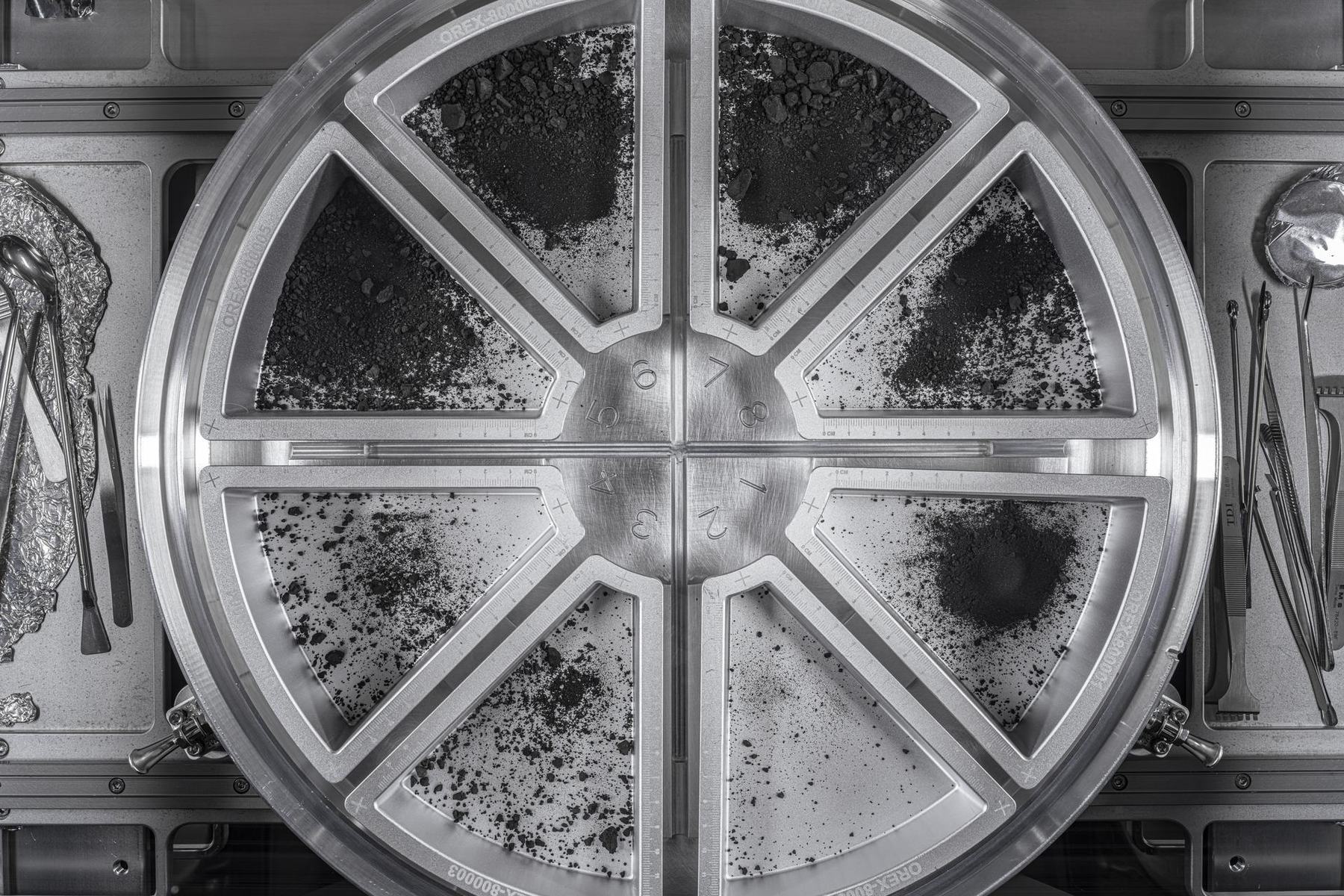
NASA holds 121.6 grams of asteroid Bennu, brought home by OSIRIS-REx in 2023. Scientists study it, museums display pieces of it, and I have found no record of any State objecting. That tells you little about asteroid mining. A scientific sample is one thing. A company selling tonnes of platinum or water from an object nobody can own is another.
So is asteroid mining legal? The answer has two parts. It is probably lawful to do. Who owns the result depends on which court you ask. We have written about who owns what on the Moon. This piece looks at asteroids, the national laws and the UN text that was circulated six weeks ago.
What the Outer Space Treaty says
Three articles of the Outer Space Treaty frame the argument.
Article I gives all States freedom of “exploration and use” of outer space, including celestial bodies. Article II says outer space, “including the Moon and other celestial bodies, is not subject to national appropriation by claim of sovereignty, by means of use or occupation, or by any other means”. An asteroid is a celestial body, so no State can claim one. Article VI makes States responsible for their companies and requires “authorization and continuing supervision”.
The treaty never mentions resources. Supporters of mining read extraction as a form of use, and compare it with fishing on the high seas: nobody owns the sea, but the catch belongs to the fisher. Critics reply that an asteroid is not an ocean. Some are small enough that taking resources could consume much of the object, which starts to look like appropriation by another name. No court or tribunal has ruled on either view.
Does the Moon Agreement ban it?
The one treaty that addresses the point head on is the Moon Agreement of 1979. Despite the name, Article 1 extends it to “other celestial bodies within the solar system”, so it covers asteroids. Article 11 calls the Moon and its natural resources “the common heritage of mankind”, says natural resources in place cannot become anyone’s property, and commits parties to set up an international regime “as such exploitation is about to become feasible”.
That reads like a real constraint, but only for its parties. There are 17 of them, and the United States, China and Russia are not among them. In Executive Order 13914 of April 2020 the US said it does not consider the agreement “an effective or necessary instrument” and does not view outer space as “a global commons”.
The national laws
Four States have legislated, and a fifth has made policy. They share a pattern: each gives the extractor rights, and each says those rights sit within international obligations.
The United States went first. Under 51 USC 51303, added in November 2015, a US citizen engaged in commercial recovery of “an asteroid resource or a space resource” is “entitled to” what it obtains, including to own, transport, use and sell it, “in accordance with applicable law, including the international obligations of the United States”. An asteroid resource is a space resource found on or within a single asteroid, and a space resource is “an abiotic resource in situ in outer space”. Section 403 of the same Act adds that the US does not thereby assert “sovereignty or sovereign or exclusive rights or jurisdiction over, or the ownership of, any celestial body”.
Luxembourg’s law of 20 July 2017 is shorter on the point and fuller on regulation. Article 1 reads: “Space resources are capable of being owned.” It is also a real licensing regime. No one may explore or use space resources without written authorisation, applicants must be Luxembourg companies of listed types, fees run from 5,000 to 500,000 euros, the operator is “fully responsible” for damage, and acting without authorisation can bring prison and a fine of up to 1,250,000 euros.
The UAE regulates through its 2019 space law and Cabinet Resolution No. 19 of 2023. Article 7 lets an authorised operator exercise rights of ownership, purchase, sale, trade, transport, storage and use, and Article 6 lets the Space Agency allocate priority rights from a national database.
Japan’s Act No. 83 of 2021, which took effect on 23 December 2021, says that a business acquires ownership of resources mined under its approved plan once it possesses them with intent to own them. Article 6 says attention must be paid to not hindering “the sincere implementation of treaties”, and that nothing may “unjustly harm the interests of other States” using outer space.
India’s Space Policy 2023 uses language close to the American statute, saying non-governmental entities “shall be entitled to possess, own, transport, use, and sell” resources they recover. It is a policy, not legislation, so its force in an Indian court is untested.
The limit of all these texts is the same. A State can decide what its own courts will recognise. It cannot create a title that binds another State. As Güneş Ünüvar wrote in Opinio Juris in September, national legislation has no international effect. If a Japanese company and a Luxembourg company dispute the same ore, there is no international register to consult.
The Artemis Accords and the UN draft
The Artemis Accords state in Section 10 that “the extraction of space resources does not inherently constitute national appropriation under Article II of the Outer Space Treaty”. The State Department counts 77 signatories as of October 2026, with Vietnam the most recent. The Accords are a political statement, but 77 States saying the same thing is evidence of how they read Article II.
The wider forum is the COPUOS Working Group on Legal Aspects of Space Resource Activities. A consolidated draft of recommended principles was published around an intersessional meeting on 24 September 2026. I could not open the draft itself, so I rely on Ünüvar’s account of it. Principle 2 says States, international organisations and non-governmental entities may conduct space resource activities consistent with international law, and that treaty-compliant extraction does not in itself amount to national appropriation. The preamble says resources in place form part of outer space, wording Russia pressed for, but the draft imposes no moratorium. The United States, Canada and the United Kingdom opposed using “shall” in a non-binding text.
Benefit-sharing in Principle 9 is voluntary. Principle 8 encourages national legislation on authorisation. And the draft says nothing on who holds title to extracted material. That silence is the most telling part. Five years of talks have produced something close to agreement that mining can happen, and no agreement on what the miner ends up owning.
Who would license a mission?
Here the US statute has a gap. Section 51303 gives a right but creates no licence. A US mission to an asteroid would need FAA launch and payload approval and FCC spectrum authority, as we explained in our guide to who regulates space in the US, but no agency authorises the extraction itself. The Office of Space Commerce’s mission authorisation pilot is voluntary, and a certificate under it has no direct legal effect. Article VI still requires continuing supervision of the activity, so the US relies on a patchwork to meet an obligation Luxembourg meets with a single statute.
General rules also apply. Article IX requires due regard for others and consultation where an activity could cause harmful interference. The Liability Convention applies to damage from the mining spacecraft.
Is anyone actually doing it?
Not yet. Payload reported in June that AstroForge’s first deep-space craft, Odin, launched in February 2025 and failed about 530,000 miles from Earth when its solar array did not deploy. Its 200 kg successor, DeepSpace-2, is due to fly before the end of 2026 to rendezvous with and image an asteroid. That is reconnaissance, not extraction.
The closest thing to a commercial precedent came from the Moon. In December 2020 NASA awarded contracts worth $25,001 in total to buy small amounts of lunar regolith from companies, including a $1 award to Lunar Outpost. Mike Gold, then a NASA official, said there was “important policy and precedent that’s being set”. As I read it, the point was to build State practice, and that is how resource law is likely to develop: through conduct, long before any tribunal gets involved.
What I would watch
The first is the Legal Subcommittee in April 2027. Five more intersessional meetings are planned before then. COPUOS works by consensus, so if the principles are adopted they would be its first instrument devoted to space resources, and watch whether the silence on ownership survives.
The second is DeepSpace-2. A successful rendezvous would move asteroid mining from theory to a mission a regulator has to think about, and it would test how US agencies handle a mission whose stated purpose is resource recovery.
The third is the first real sale. Title only matters when someone pays for material and a third party disputes it. Until then, these laws are mainly tools for attracting companies and investors, and lenders will decide how much comfort they give.
Questions people actually ask
Is asteroid mining legal?
Probably yes for most States, though it has never been tested. The Outer Space Treaty bans national appropriation of asteroids but protects use, and most spacefaring States read extraction as use. The United States, Luxembourg, the UAE and Japan permit it by law. The Moon Agreement is stricter but has only 17 parties.
Can anyone own an asteroid?
No. Article II of the Outer Space Treaty says celestial bodies are not subject to national appropriation by any means. Because Article VI makes States responsible for their companies, a private company cannot claim an asteroid either. Even the national mining laws, including section 403 of the US Act, disclaim ownership of celestial bodies.
Can a company own minerals mined from an asteroid?
Under some national laws, yes. 51 USC 51303 entitles US citizens to own what they recover, Luxembourg’s 2017 law says space resources can be owned, and the UAE and Japan have similar rules. Those rights bind each State’s own courts. No international rule yet confirms them, and the UN draft of 2026 leaves the point open.
Which countries have space mining laws?
The United States (2015), Luxembourg (2017), the UAE (2019 law and 2023 Cabinet Resolution) and Japan (2021) have legislated. India’s Space Policy 2023 says non-governmental entities may possess, own, transport, use and sell space resources they recover, but it is a policy, not a statute.
Does the Moon Agreement apply to asteroids?
Yes. Article 1 extends it to other celestial bodies in the solar system. Article 11 says natural resources in place cannot become property and calls for an international regime once exploitation is feasible. Only 17 States are parties, and the United States formally rejected the agreement in Executive Order 13914.
Has anyone mined an asteroid yet?
No. NASA, Japan and others have returned scientific samples, such as the 121.6 grams NASA collected from Bennu, but no company has extracted resources commercially. AstroForge’s Odin spacecraft failed after launch in 2025, and its DeepSpace-2 rendezvous mission is due to launch before the end of 2026.

Anuj KumarEditor-in-Chief
Anuj Kumar is the founder of Legal Desire Media and publishes Fashion Law Journal and Space Law Journal.
Space Law Journal is a joint initiative of Legal Desire Media and Odyogeek. Spotted something we got wrong, or want to respond? Write to space@legaldesire.com.