Is It Legal to Own a Moon Rock? Apollo Samples, Meteorites and the Cases That Decided Them
Is it legal to own a moon rock? Why Apollo samples stay federal property, what the Davis and Carlson cases decided and when meteorites and Luna samples sell.
Few objects carry as much legal baggage per gram as a piece of the Moon. Some fragments sell openly at auction houses. Others have led to sting operations, seizures and federal lawsuits. The difference is not the rock. It is the route it took to Earth, the paperwork that came with it and, in the United States, whether the federal government thinks it still owns it.
This is a practical guide to who owns lunar material, what the courts have said and what changes once companies start bringing material back themselves. It complements our explainers on who owns what on the Moon and on buying land on the Moon, which deal with the surface rather than the samples.
The short answer
There are three kinds of lunar material in human hands, and the law treats them differently.
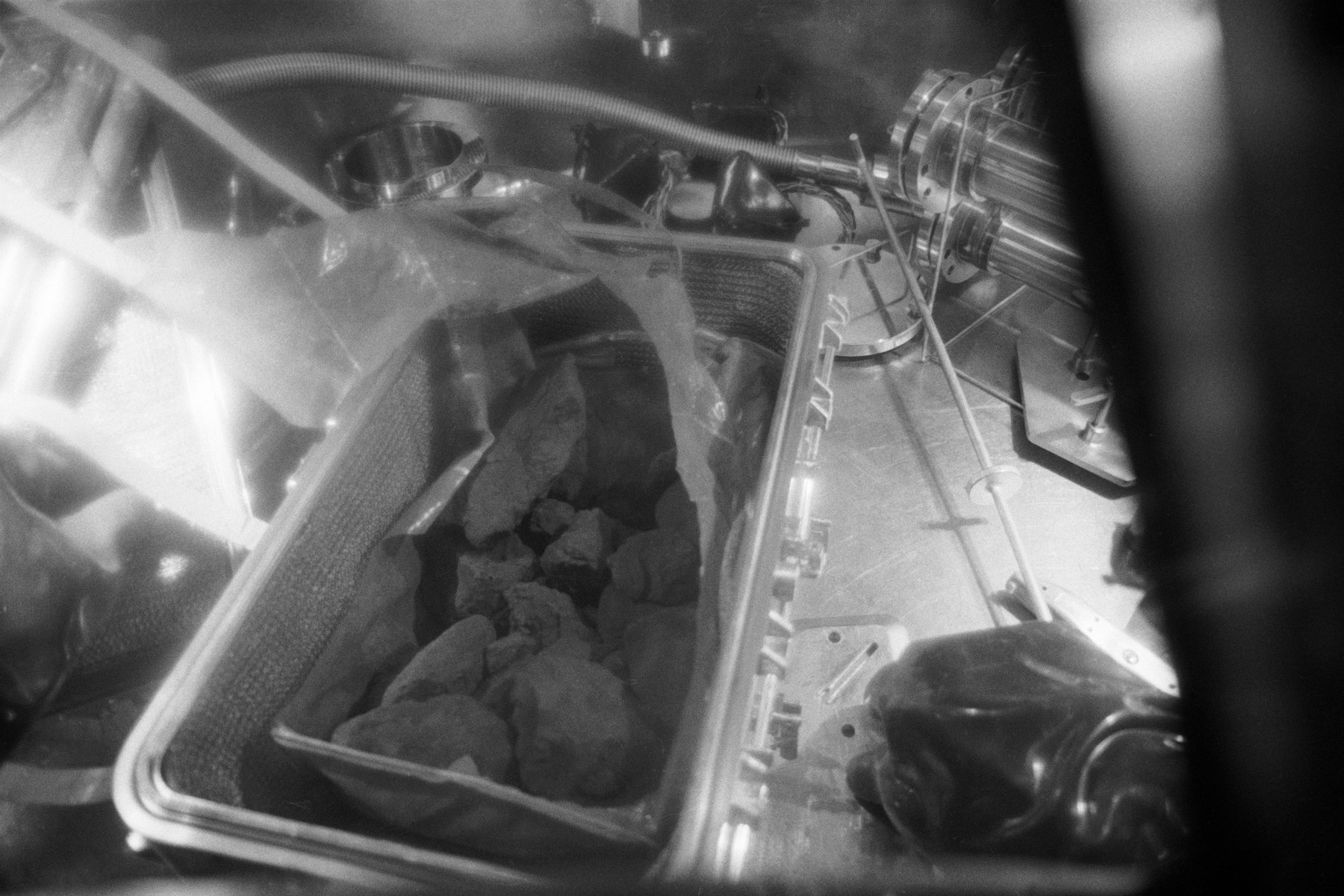
Apollo samples, the 382 kg or so returned by the six US landing missions, were collected by government astronauts on government missions. NASA treats them as federal property that has never been released to private owners.
Samples from the Soviet Union’s robotic Luna missions are rarer still, and at least one small set was given away and later sold with documented title.
Lunar meteorites are pieces of the Moon knocked off by impacts that landed on Earth naturally. They are treated like any other meteorite, so ownership depends on the law of the place where they were found.
Apollo samples: the government’s position
NASA’s position is blunt. When RR Auction in Boston offered a vial of about 40 milligrams of Apollo 11 dust and three cockroach carcasses from a 1969 experiment in June 2022, with an expected price of at least $400,000, NASA’s lawyers wrote that the material “belong[s] to NASA and no person, university, or other entity has ever been given permission to keep them”, according to the Associated Press report. The lot was pulled.
Congress has reinforced the point. Public Law 112-185, signed on 5 October 2012, confirms that astronauts who flew in the Mercury, Gemini and Apollo programmes through the Apollo-Soyuz Test Project “shall have full ownership of and clear title” to artifacts they received, such as checklists, flight manuals and personal-use items, and that the federal government has no claim against later buyers. The definition then adds one sentence: “The term does not include lunar rocks and other lunar material.” An astronaut can sell a flown checklist. A flown Moon rock is a different matter.
The criminal law that sits behind NASA’s position is general. In the Davis case the agent’s warrant cited 18 U.S.C. 641, which punishes anyone who “without authority, sells, conveys or disposes of any record, voucher, money, or thing of value of the United States”, and anyone who retains such property knowing it to have been converted. The warrant did not rely on any statute specific to lunar material.
Davis v. United States: the Denny’s sting
The case most people remember is Davis v. United States, decided by the Ninth Circuit on 13 April 2017. The facts, as the court described them, explain why.
Joann Davis and her late husband Robert had worked for North American Rockwell, a NASA contractor, where he became a manager on the Apollo project. He received two lucite paperweights, one containing a “rice-grain-sized fragment of lunar material”, the other a piece of the Apollo 11 heat shield. Family lore, which the court called “unverified”, held that Neil Armstrong gave them to him.
In 2011, facing her son’s medical bills, Davis emailed NASA asking for help to find a buyer. The email went to NASA’s Office of Inspector General. An informant posing as a broker called her, and on 19 May 2011 she met him at a Denny’s in Lake Elsinore, California, believing she was completing a sale. Officers seized the paperweight, and she was questioned in the car park for up to two hours. She was 74. The court recorded that at no point had anyone told her “that all lunar material is property of the U.S. government or that her possession of the paperweights was illegal.” The US Attorney later declined to prosecute.
The appeal was about the officer, not the rock. The Ninth Circuit held that the agent was not entitled to qualified immunity on her Fourth Amendment claim, because a jury could find the detention “unreasonably prolonged and degrading”. It did not decide whether the government owned the fragment. That is the key point for collectors: Davis shows how NASA treats Apollo material, not that a court has confirmed its title in every case.
Carlson: the bag that was sold by mistake
The other leading case went the other way. In February 2015 Nancy Carlson of Illinois paid $995 at a US Marshals Service auction for a bag that turned out to have been used on Apollo 11 to bring back lunar samples. It had been forfeited from Max Ary, a former museum curator convicted in 2006 of stealing and selling space artifacts, and nobody realised at the time of forfeiture what it was.
When Carlson sent the bag to NASA for authentication, NASA kept it. The government asked the court to undo the sale. On 14 December 2016 Judge J. Thomas Marten of the US District Court for Kansas refused, holding, as collectSPACE reported, that Carlson was “a good faith purchaser, in a sale conducted according to law” and that “she is entitled to possession of the bag”. He described NASA as “a victim in this case, not a wrongdoer”, but found no instance of a court rescinding a sale to a bona fide purchaser after a final forfeiture order.
The bag sold at Sotheby’s on 20 July 2017 for $1.8 million, according to the Associated Press. There was a sequel. Carlson sued NASA again in 2019 over dust samples taken from the bag during testing, NASA settled and returned five of six sample stubs, and those stubs sold at Bonhams in April 2022 for just over $500,000, as National Geographic reported.
The lesson from Carlson is narrow but real. A government sale conducted according to law can pass good title, even to something the government would never knowingly have sold. Our round-up of space law cases puts these disputes alongside the others that have shaped the field.
Soviet samples: the Luna 16 sales
Lunar material can be sold lawfully where a State has given it away. The clearest example is three tiny fragments returned by the Soviet Luna 16 probe in 1970 and presented to Nina Ivanovna Koroleva, widow of the Soviet space programme’s chief designer Sergei Korolev. They sold at Sotheby’s in December 1993 for $442,500 and again on 29 November 2018 for $855,000. collectSPACE described them as the only known pieces collected from the lunar surface to have been legally sold, and said there were no other documented sales with clear title of Soviet-retrieved Moon rocks.
Lunar meteorites: finders and landowners
Meteorites from the Moon are a separate category. They arrived naturally, so no space agency owns them, and the ordinary law of the place where they land decides who does. In the United States the starting point is an old property case, Goddard v. Winchell, 86 Iowa 71 (1892), in which the Iowa Supreme Court held that a meteorite which fell on leased prairie land belonged to the landowner rather than the neighbour who dug it up.
On federal land, the government is the landowner. The Bureau of Land Management’s Instruction Memorandum 2012-182 stated that meteorites found on public land “belong to the Federal Government”, allowed casual collection of up to ten pounds per person per year for personal use, barred casual collectors from selling what they found and required a permit for commercial collection. Other countries have their own rules, and some treat meteorites as protected heritage, so the provenance of a lunar meteorite matters as much as that of an Apollo sample.
What changes when companies collect lunar material
Everything above concerns material returned by governments or delivered by nature. That is changing. Under 51 U.S.C. 51303, added in 2015, a US citizen engaged in commercial recovery of a space resource “shall be entitled to any asteroid resource or space resource obtained, including to possess, own, transport, use, and sell” it, in accordance with applicable law and US international obligations.
NASA has already tested the idea. On 3 December 2020 it selected four companies to collect small amounts of lunar regolith and transfer ownership to NASA, paying Lunar Outpost $1, ispace Japan and ispace Europe $5,000 each and Masten Space Systems $15,000, as SpacePolicyOnline reported. NASA said at the time that the United States “is not claiming ownership of the Moon, only of its resources.”
Whether extraction is compatible with the non-appropriation rule in Article II of the Outer Space Treaty is still debated, as is the position of the few States party to the Moon Agreement. But for a commercially returned sample, the US statute gives the company a title that no Apollo sample has ever had.
What I would watch
The first is the first commercial sale of lunar material collected by a company. When it happens, the seller will rely on 51 U.S.C. 51303 or an equivalent foreign law, and buyers will want to see the authorisation and chain of title that make it different from an Apollo sample.
The second is how NASA handles Artemis samples. Material collected by government astronauts on future missions will start out as federal property, just as Apollo samples did. Any programme to share or loan it will need clearer rules than the ones that left Joann Davis in a car park.
The third is meteorite regulation. As lunar meteorites become more valuable, expect more disputes about where a stone was found and whether it was exported lawfully.
Questions people actually ask
Is it legal to own a moon rock?
It depends on the rock. Lunar meteorites that fell to Earth naturally can be owned, subject to the law of the place where they were found. Soviet Luna 16 samples with documented title have been sold legally. NASA treats Apollo samples as US government property and has never authorised private ownership, and Congress excluded lunar material from the 2012 law confirming astronauts’ ownership of their souvenirs.
Can astronauts keep or sell moon rocks?
No. Public Law 112-185 of 5 October 2012 gives Mercury, Gemini and Apollo astronauts full ownership of artifacts such as checklists, manuals and personal-use items, but the definition of artifact expressly excludes lunar rocks and other lunar material.
What happened in Davis v. United States?
Joann Davis, 74, tried to sell a paperweight containing a rice-grain-sized moon rock that her late husband, an Apollo contractor manager, had received. NASA’s Inspector General ran a sting at a Denny’s in Lake Elsinore, California, on 19 May 2011. On 13 April 2017 the Ninth Circuit held that the agent was not entitled to qualified immunity for her detention. Prosecutors declined to charge her.
Who owns the Apollo 11 lunar sample bag sold at a government auction?
Nancy Carlson bought it for $995 at a US Marshals Service auction in 2015 after it was forfeited from a convicted artifacts thief. On 14 December 2016 a federal judge in Kansas held that she was a good faith purchaser and entitled to the bag. It sold at Sotheby’s on 20 July 2017 for $1.8 million.
Have moon rocks ever been sold legally?
Yes. Three Luna 16 fragments given to the widow of Soviet chief designer Sergei Korolev sold at Sotheby’s for $442,500 in 1993 and for $855,000 on 29 November 2018. Lunar meteorites are also bought and sold, subject to the rules of the country where they were found.
Can a company own moon rocks it collects itself?
Under US law, yes. Since 2015, 51 U.S.C. 51303 has entitled US citizens engaged in commercial recovery of space resources to possess, own, transport, use and sell them, in accordance with applicable law and US international obligations. Luxembourg, the UAE and Japan have adopted their own space resources laws.

Anuj KumarEditor-in-Chief
Anuj Kumar is the founder of Legal Desire Media and publishes Fashion Law Journal and Space Law Journal.
Space Law Journal is a joint initiative of Legal Desire Media and Odyogeek. Spotted something we got wrong, or want to respond? Write to space@legaldesire.com.