Is It Legal for a Satellite to Shadow Another? Cosmos 2612 and the Law of Proximity Operations
Is it legal for a satellite to shadow another? How the Outer Space Treaty and FCC and NOAA rules apply to proximity operations after Russia's Cosmos 2612.
For most of the space age, getting close to another satellite was rare, expensive and done by governments. Today it is routine. Servicing vehicles dock with ageing communications satellites, inspection craft photograph debris, and military satellites shadow each other. The law has not caught up, and October’s events in low Earth orbit showed why that matters.
This piece explains what international and national law say about rendezvous and proximity operations, usually shortened to RPO, and where the gaps are.
What happened with Cosmos 2612
According to the Center for Strategic and International Studies, Russia launched six satellites, Cosmos 2609 to Cosmos 2614, in April 2026. A month later five of them changed their inclination to match the orbital plane of a commercial synthetic aperture radar satellite operated by ICEYE, a company founded in Finland. CSIS describes the target as US-registered and supporting Ukraine. On 26 May, citing commercial tracking data, CSIS says Cosmos 2609 passed within 2.5 km of it.
Over two weeks beginning on 30 September, Cosmos 2612 carried out a new series of manoeuvres. AeroTime reported that the satellite tracker Jonathan McDowell said on 17 October that Cosmos 2612 was “stationkeeping within 5 km or less of ICEYE X36”, and that the Dutch tracker Marco Langbroek estimated the two may have come within a few hundred metres around 01:35 UTC on 18 October. Langbroek found no orbital evidence that the ICEYE satellite had been struck. Public tracking data is not precise enough to give a firm minimum distance. ICEYE told AeroTime: “We are aware of the situation and tracking it closely.”
The United States raised the matter at the UN. At the First Committee on 21 October, according to the UN’s meeting coverage, the US representative said Cosmos 2612 “exhibited threatening behavior”, “intentionally maneuvering dangerously close to a commercial satellite”.
None of that, on its own, establishes a breach of international law. That is the problem.
Is it legal to approach another satellite?
Yes, as a general rule. No space treaty prohibits rendezvous, inspection or close approach, and no treaty requires the consent of the other satellite’s owner. Freedom of exploration and use in Article I of the Outer Space Treaty applies to all States, and that includes manoeuvring.
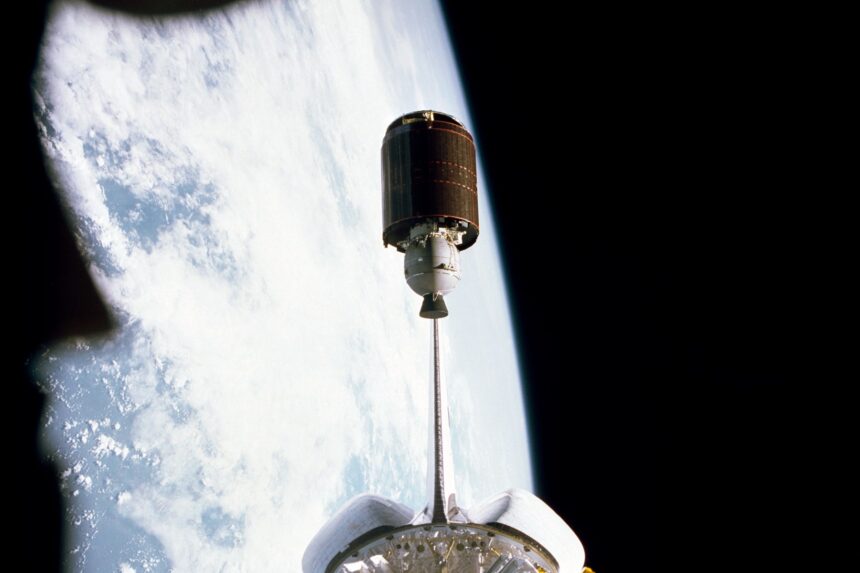
Commercial practice shows why a blanket ban would not work. On 25 February 2020 Northrop Grumman’s Mission Extension Vehicle docked with Intelsat 901 above the geostationary belt, which SpacePolicyOnline described as the first docking between two commercial satellites. Missions like that, and the government-funded rescue we discussed in our note on in-orbit servicing and mission authorisation, are proximity operations by definition. The difference between them and Cosmos 2612 is consent and purpose, not physics.
The rules that do apply
Four sets of rules frame what a State may do near someone else’s satellite.
The first is Article IX of the Outer Space Treaty. States must conduct their activities “with due regard to the corresponding interests of all other States Parties”. If a State has reason to believe an activity planned by it or its nationals “would cause potentially harmful interference” with others’ activities, it “shall undertake appropriate international consultations before proceeding”. A State that fears another’s planned activity “may request consultation”. These are real obligations, but they are procedural and loosely worded, and nothing in the treaty defines how close is too close.
The second is the UN Charter, which Article III of the treaty applies to space. A close approach is not a use of force. Damaging, disabling or seizing another State’s satellite could be, and so could an explicit threat to do so. Between approach and attack lies a wide grey zone in which a manoeuvre may be read as surveillance, signalling or rehearsal. Our analysis of anti-satellite weapons and international law looks at where co-orbital systems sit in that picture.
The third is liability. Under Article III of the Liability Convention, damage caused in space by one State’s space object to another’s is compensable “only if the damage is due to its fault”. A deliberate close approach that ends in a collision would make fault easier to prove than a random conjunction would. Our Liability Convention explainer covers how claims work.
The fourth is State responsibility. Article VI makes States internationally responsible for national activities in space, including those of private companies, and requires “authorization and continuing supervision” of non-governmental activities. Where a commercial satellite supports a foreign military, that rule ties the State responsible for it to what it does. Moscow has drawn its own conclusion: a Space Force threat fact sheet, as AeroTime noted, records Russian warnings that commercial satellites supporting military operations “may become a legitimate target for retaliation”.
What national regulators require
National law can be stricter, but only for the regulator’s own operators. Two US examples show the shape.
The FCC requires applicants for satellite authorisations to file “a statement disclosing planned proximity operations, if any”, together with the debris and collision risks and how they will be mitigated, under 47 CFR 25.114(d)(14)(vi). Disclosure is not prohibition, but it gives the FCC a basis for conditions.
NOAA goes further for imaging. Under 15 CFR Part 960, licensees in Tiers 2 and 3 may take “resolved imaging” of another artificial resident space object, meaning an image of 3 x 3 pixels or more, “only with the written consent of the registered owner” and with five days’ notice to the Secretary of Commerce, whose licensing office sits in NOAA. A US company therefore needs permission to photograph a foreign satellite in detail. A foreign government satellite inspecting a US one is bound by no equivalent rule. Our explainer on NOAA remote sensing licences explains the tier system.
Norms instead of rules
Because the treaties are thin, governments have turned to norms. On 7 July 2021 the US Secretary of Defense issued five “Tenets of Responsible Behavior in Space”, reported by Breaking Defense, including “Maintain safe separation and safe trajectory” and “Communicate and make notifications to enhance the safety and stability of the domain”.
At the UN, General Assembly resolution 75/36, “Reducing space threats through norms, rules and principles of responsible behaviours”, was adopted on 7 December 2020 by 164 votes to 12 with six abstentions, as the UK’s disarmament ambassador recorded. It asked States to identify which behaviours are responsible, irresponsible or threatening. RPO has since become one of the issues in that debate. On 21 October 2026 the chair of the current Open-Ended Working Group on preventing an arms race in outer space listed “promoting the safe operation of space objects, including rendezvous and proximity operations and unauthorized interference” as one of the group’s themes.
The split between approaches is familiar. The US and its allies favour behavioural norms. Russia and China favour a treaty banning the placement of weapons in orbit, which the US calls unverifiable. Neither approach yet gives a clear answer to the Cosmos 2612 question: at what distance, with what notice and for how long does shadowing become irresponsible? Our piece on weapons in orbit and the Outer Space Treaty sets out why the treaty does not settle it.
What I would watch
The first is whether any State invokes the Article IX consultation procedure over an RPO campaign. It would show whether that procedure has any practical value in a dispute of this kind.
The second is whether regulators adopt notification rules for proximity operations, such as advance notice to the operator being approached. Commercial servicing companies have an interest in clear rules, because their legitimate missions look the same on a tracking screen as a hostile approach.
The third is insurance and contracts. If shadowing of commercial satellites becomes common, expect policy wordings and launch and operations contracts to address it, including whether a hostile approach counts as an excluded act of war.
Questions people actually ask
Is it legal for a satellite to approach another satellite?
Generally yes. No space treaty prohibits rendezvous or close approaches, and none requires the target owner’s consent. The Outer Space Treaty requires due regard for other States’ interests and consultations before activities that could cause potentially harmful interference, and the UN Charter prohibits the threat or use of force.
What are rendezvous and proximity operations?
Rendezvous and proximity operations, or RPO, are manoeuvres that bring one spacecraft close to another, for docking, inspection, servicing, refuelling or debris removal. They are also used for military surveillance. Northrop Grumman’s MEV-1 docking with Intelsat 901 on 25 February 2020 was the first docking between two commercial satellites.
What did Cosmos 2612 do in October 2026?
After manoeuvres beginning on 30 September 2026, Russia’s Cosmos 2612 moved close to ICEYE-X36, a commercial radar satellite. Trackers estimated it was within 5 km by 17 October and possibly within a few hundred metres on 18 October. The US told the UN First Committee on 21 October that it had manoeuvred “dangerously close”.
Who is liable if a proximity operation causes a collision?
Under Article III of the Liability Convention, a launching State is liable for damage its space object causes to another State’s space object in orbit only if the damage is due to its fault. A deliberate close approach that ends in a collision would make fault easier to establish than an accidental conjunction.
Do US companies need permission to photograph other satellites?
Often, yes. Under NOAA’s rules in 15 CFR Part 960, Tier 2 and Tier 3 licensees may take resolved images of another artificial resident space object only with the written consent of its registered owner and five days’ notice to the Commerce Department. The FCC separately requires disclosure of planned proximity operations.
Are there international norms on proximity operations?
There are norms but no binding rules. UN General Assembly resolution 75/36 of December 2020 started work on responsible behaviours in space, and the US Department of Defense’s 2021 tenets include maintaining safe separation and safe trajectory. The UN working group on preventing an arms race in outer space lists RPO among its themes.

Anuj KumarEditor-in-Chief
Anuj Kumar is the founder of Legal Desire Media and publishes Fashion Law Journal and Space Law Journal.
Space Law Journal is a joint initiative of Legal Desire Media and Odyogeek. Spotted something we got wrong, or want to respond? Write to space@legaldesire.com.