Are the Apollo Landing Sites Protected? The Law on Lunar Heritage Explained
Are the Apollo landing sites protected? What the Outer Space Treaty, the One Small Step Act, NASA's 2011 keep-out zones and the Artemis Accords require.
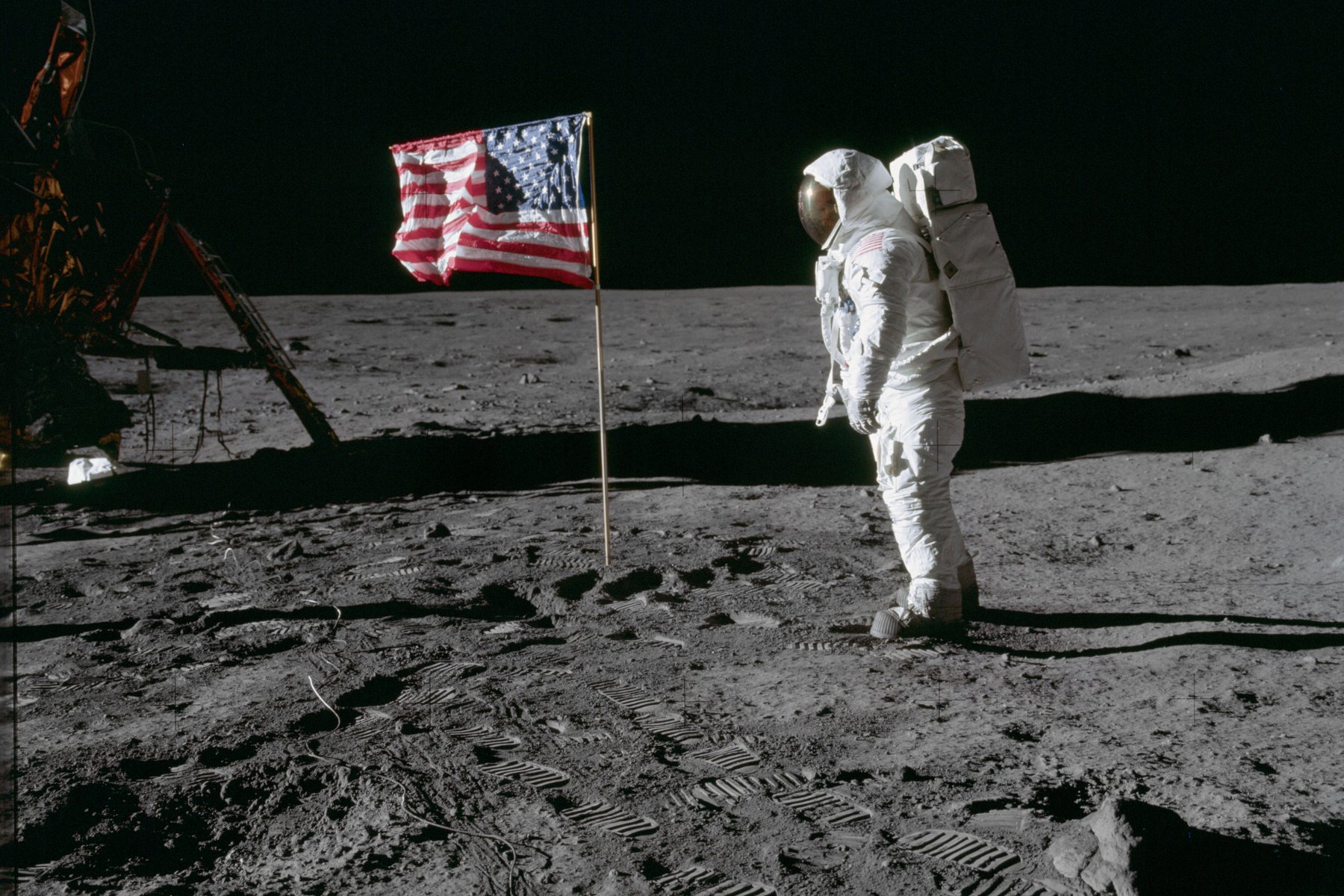
Neil Armstrong took this photograph of Buzz Aldrin beside the flag at Tranquility Base on 20 July 1969. The lunar module’s descent stage is on the left, and the astronauts’ bootprints cross the foreground. All of it is still there. Within the next few years, robotic landers from several countries and companies, and crews under NASA’s Artemis programme, will be operating on the Moon. Some may land near the places humans have already been.
So are the Apollo landing sites protected? The short answer is yes for NASA and its partners, and only partly for everyone else. This explainer sets out who owns what is on the Moon, what the treaties say, what US law requires, and where the gaps are.
Who owns what was left on the Moon?
The objects, but not the ground. Article VIII of the Outer Space Treaty provides that “Ownership of objects launched into outer space, including objects landed or constructed on a celestial body, and of their component parts, is not affected by their presence in outer space or on a celestial body or by their return to the Earth.” The Apollo descent stages, rovers, experiments and tools are United States government property. NASA’s own guidance says so directly: “The USG continues to maintain ownership of NASA hardware and other property on the surface of the moon, including the Apollo artifacts.”
The ground is a different matter. Article II says outer space, “including the moon and other celestial bodies, is not subject to national appropriation by claim of sovereignty, by means of use or occupation, or by any other means.” The United States cannot claim the patch of regolith around Apollo 11, fence it off or declare it a national park. We covered the wider point in our explainers on the Outer Space Treaty and on whether you can buy land on the Moon.
Bootprints and rover tracks are not objects launched into space, so Article VIII does not protect them as property. They are protected, if at all, only as part of the area around the hardware.
The same split applies to material taken from the Moon. Apollo samples are treated as federal property, a story told in our piece on whether it is legal to own a moon rock.
What does the Outer Space Treaty require of other lunar missions?
Article I gives every State “free access to all areas of celestial bodies”. That makes a legal keep-out zone hard to justify: a State cannot exclude others from part of the Moon.
Article IX does most of the protective work. States must conduct their activities “with due regard to the corresponding interests of all other States Parties”. If a State has reason to believe an activity planned by it or its nationals “would cause potentially harmful interference” with the activities of other States, it “shall undertake appropriate international consultations before proceeding”. Another State may request consultation.
Damaging a historic US site, or contaminating instruments that are still in use, is arguably harmful interference with US activities. NASA’s guidance notes that some Apollo sites are still active, citing the laser retro-reflectors, and that the hardware is a long-term record of how materials weather on the Moon. But Article IX sets a duty to consult, not a prohibition. It does not say how far away a lander must stay.
What did NASA recommend in 2011?
On 20 July 2011 NASA published NASA’s Recommendations to Space-Faring Entities: How to Protect and Preserve the Historic and Scientific Value of U.S. Government Lunar Artifacts, updated on 28 October 2011. It was written after commercial teams asked NASA how close they could approach US hardware. The document is candid about its status: “These recommendations are not legal requirements; rather they are technical recommendations for consideration by interested entities.”
It applies to US government artefacts: Apollo landing and roving hardware, uncrewed landers such as Surveyor, impact sites such as Ranger and the spent S-IVB stages, equipment left on the surface, and “Specific indicators of U.S. human, human-robotic lunar presence, including footprints, rover tracks”. The main recommendations are these.
| Boundary | Recommendation |
|---|---|
| Descent and landing | A visiting lander’s descent path should not cross a 2.0 km radius around a heritage landing site such as Apollo or Surveyor, to avoid overflight, plume debris and crashes |
| Apollo 11 exclusion zone | Visiting vehicles should stay 75 m from the lunar module descent stage, which encloses all the hardware and human activity of that mission |
| Apollo 17 exclusion zone | 225 m from the lunar module descent stage, because the crew used a rover |
| Apollo 12 and 14 to 16 | Exclusion zones set around individual artefacts by component type, allowing close inspection |
| Surveyor spacecraft | A 1 m buffer around each spacecraft |
The reasoning on Apollo 11 is plain: “It is desired to maintain the integrity of the Apollo 11 and Apollo 17 sites.” The concern is not only touching the hardware. NASA’s plume analysis found that particles blown by a descent engine can reach between 300 and 2,000 metres per second and keep going until they hit the surface far away, which is why the landing boundary is so much wider than the surface one.
What does the One Small Step Act do?
Congress turned the 2011 recommendations into a requirement for NASA’s own activities in the One Small Step to Protect Human Heritage in Space Act, Public Law 116-275, approved on 31 December 2020.
Its findings describe the landing sites as “of outstanding universal value to humanity” and “the first archaeological sites with human activity that are not on Earth”. Section 3 then requires the NASA Administrator to:
- “add the recommendations in subsection (b) as a condition or requirement to contracts, grants, agreements, partnerships or other arrangements pertaining to lunar activities carried out by, for, or in partnership with” NASA;
- “inform other relevant Federal agencies” of the recommendations; and
- “encourage the use of best practices” consistent with them by those agencies.
The recommendations are the 2011 document “and any successor recommendations, guidelines, best practices, or standards” NASA issues on due regard and harmful interference with Apollo landing site artefacts. So NASA can update the rules without a new Act.
The Administrator may waive the requirement for an individual contract or agreement, but only on a finding that compliance “would be unduly prohibitive” to an activity of “legitimate and significant historical, archaeological, anthropological, scientific, or engineering value”, and only if the finding goes to the House Science Committee and Senate Commerce Committee at least 30 days before the waiver takes effect.
Three limits matter. The Act concerns Apollo landing site artefacts, although the 2011 recommendations it adopts also cover other US hardware. It binds NASA and those working “by, for, or in partnership with” NASA, which in practice means companies flying NASA payloads or working under NASA contracts and agreements, including Space Act Agreements. And it does not regulate a lander with no NASA link, whatever its nationality. The Act’s sense of Congress recognises the gap: “as commercial enterprises and more countries acquire the ability to land on the Moon, it is necessary to encourage the development of best practices”.
What do the Artemis Accords add?
Section 9 of the Artemis Accords is titled “Preserving Outer Space Heritage”. The signatories “intend to preserve outer space heritage, which they consider to comprise historically significant human or robotic landing sites, artifacts, spacecraft, and other evidence of activity on celestial bodies in accordance with mutually developed standards and practices”, and to use their experience to contribute to “multilateral efforts to further develop international practices and rules”.
Two things stand out. First, the definition is wider than the US statute. It covers any historically significant site, including robotic landings, and is not limited to American hardware. Second, it is a statement of intent. The Accords are a political commitment, not a treaty, and Section 9 leaves the standards to be “mutually developed”.
NASA’s Artemis Accords page says Vietnam became the 78th signatory on 28 October 2026. That is a large group of States committed in principle to protecting heritage sites, but it does not include every State with lunar ambitions. Our Artemis Accords explainer covers the rest of the text.
Does heritage law on Earth apply?
Not in any practical sense. The UNESCO World Heritage Convention is built on territory: Article 3 asks each State Party to identify properties “situated on its territory”, and Article 4 puts the duty to protect heritage “situated on its territory” primarily on that State. Because Article II of the Outer Space Treaty prevents any State from having territory on the Moon, no State can nominate Tranquility Base.
National heritage listings have been tried. At its hearing on 29 January 2010, the California State Historical Resources Commission placed roughly 106 objects left at Tranquility Base on the California Register of Historical Resources, according to the state’s preservation newsletter. The listing expressly excluded the lunar surface and recorded that the objects belong to NASA. It recognises their importance but gives no protection on the Moon.
What I would watch
The first is whether NASA issues successor recommendations under section 3(b)(2) of the One Small Step Act. The 2011 document was described by NASA as interim guidance. Landers, rovers and hoppers are now far more capable, and the recommendations could be updated to reflect them.
The second is the Artemis Accords. Section 9 promises “mutually developed standards and practices”. Agreed distances and approach rules among the signatories would make the commitment much more concrete.
The third is the first mission that comes close to a heritage site. Under Article IX, a State planning such a mission should consult if it has reason to believe it could cause harmful interference. A first real consultation would show whether due regard can do the work of a keep-out zone.
My own view is that the present position is sensible but incomplete. Keep-out zones by statute would sit uneasily with Article II, while consultation, due regard and contract conditions do not. What is missing is a common technical standard that every State accepts, whether or not it has signed the Accords.
Questions people actually ask
Are the Apollo landing sites legally protected?
Partly. The hardware is US government property under Article VIII of the Outer Space Treaty. The One Small Step to Protect Human Heritage in Space Act of 31 December 2020 makes NASA’s 2011 protection recommendations a condition of lunar activities carried out by, for or with NASA. Missions with no NASA link are bound only by general treaty duties such as due regard under Article IX.
Who owns the flag and equipment left on the Moon?
The United States. Article VIII of the Outer Space Treaty says ownership of objects landed on a celestial body is not affected by their presence there, and NASA states that the US government continues to own its hardware on the lunar surface, including the Apollo artefacts. The lunar surface itself cannot be owned by any State under Article II.
How close can a spacecraft land to Apollo 11?
NASA’s 2011 recommendations say a visiting lander’s descent path should not cross within 2.0 km of a heritage landing site, and that vehicles on the surface should stay 75 m from the Apollo 11 lunar module descent stage. These distances are binding only on missions carried out by, for or in partnership with NASA, under the One Small Step Act.
What is the One Small Step to Protect Human Heritage in Space Act?
It is a US law, Public Law 116-275, approved on 31 December 2020. It requires NASA to add its recommendations on protecting Apollo landing site artefacts as a condition of contracts, grants, agreements and partnerships for lunar activities, to inform other federal agencies and to encourage best practices. The NASA Administrator may waive it for a specific activity after notifying Congress 30 days in advance.
Do the Artemis Accords protect historic sites on the Moon?
Section 9 of the Artemis Accords records the signatories’ intent to preserve outer space heritage, including historically significant human or robotic landing sites, artefacts and spacecraft, under mutually developed standards. It is a political commitment rather than a treaty. Vietnam became the 78th signatory on 28 October 2026.
Can the Apollo 11 site become a UNESCO World Heritage Site?
Not under the current convention. The World Heritage Convention applies to heritage situated on a State Party’s territory, and Article II of the Outer Space Treaty prevents any State from claiming territory on the Moon. California listed about 106 Tranquility Base objects on its state register in January 2010, but that listing has no legal effect on the Moon.

Anuj KumarEditor-in-Chief
Anuj Kumar is the founder of Legal Desire Media and publishes Fashion Law Journal and Space Law Journal.
Space Law Journal is a joint initiative of Legal Desire Media and Odyogeek. Spotted something we got wrong, or want to respond? Write to space@legaldesire.com.