Intellectual Property in Space: Who Owns an Invention Made in Orbit?
Intellectual property in space explained: how 35 U.S.C. 105 and Article 21 of the ISS agreement extend patents to orbit, and who owns what astronauts make.
Inventions are made in orbit all the time. Crews test metal 3D printing, run materials and biology experiments and try out hardware that companies hope to sell. Astronauts also take photographs, record videos and, on at least one famous occasion, perform a cover version of a pop song. Each of those creates a question that intellectual property lawyers usually answer by looking at a map: in which country did this happen? In orbit, the map is blank.
This explainer sets out how patent and copyright law reach space, what the International Space Station agreement adds, and where the gaps are.
The problem: intellectual property is territorial
A patent is a national right. A US patent stops others making, using or selling the invention in the United States; a German patent does the same in Germany. Copyright works on a similar basis, country by country. As the European Space Agency puts it on its page on patents and space inventions, “patents are enforceable only within the territorial boundaries of the countries designated.”
Outer space is not anyone’s territory. Article II of the Outer Space Treaty provides that outer space “is not subject to national appropriation by claim of sovereignty, by means of use or occupation, or by any other means.” So a company that patents a manufacturing process in the United States and finds a competitor using it in orbit has an obvious difficulty: the use did not happen in the United States.
The fix: jurisdiction follows the registry
The treaty supplies the starting point. Article VIII says that a State “on whose registry an object launched into outer space is carried shall retain jurisdiction and control over such object, and over any personnel thereof, while in outer space or on a celestial body.” It also provides that ownership of space objects “is not affected by their presence in outer space.”
That does not, by itself, extend a national patent statute to a satellite. It gives the State of registry the right to do so. Our explainer on the Registration Convention covers how a State becomes the State of registry, and our piece on crime in space shows the same registry principle at work in criminal law.
The US rule: 35 U.S.C. 105
The United States used that right in 1990. Section 105 of the Patent Act, headed “Inventions in outer space” and added by Public Law 101-580 of 15 November 1990, provides:
“Any invention made, used or sold in outer space on a space object or component thereof under the jurisdiction or control of the United States shall be considered to be made, used or sold within the United States for the purposes of this title.”
There are two carve-outs. The rule does not apply to a space object “specifically identified and otherwise provided for by an international agreement” to which the United States is a party, or to a space object carried on the registry of a foreign State under the Registration Convention. Subsection (b) then allows the reverse: an invention on a foreign-registered object can be treated as made in the United States if the US and the State of registry specifically agree.
Three features matter. The test is “jurisdiction or control”, which follows Article VIII. It covers making, using and selling, so it works for infringement as well as place-of-invention questions. And it is limited to inventions “on a space object or component thereof”. An activity on the lunar surface outside any spacecraft or habitat is not obviously covered, a gap that will matter if lunar bases are ever built.
Most countries have no equivalent. ESA’s page notes that only Germany adjusted its patent law, in practice, before the station agreement was signed, and that other national patent laws “do not contain provisions that would make national patent law applicable on board a spacecraft.”
The ISS answer: Article 21 of the Intergovernmental Agreement
The International Space Station needed a more detailed rule, because it is a single structure made of modules registered by different partners. The Intergovernmental Agreement, signed in Washington on 29 January 1998 by Canada, the European partner States, Japan, Russia and the United States, deals with it in Article 21.
The central sentence is in paragraph 2: “for purposes of intellectual property law, an activity occurring in or on a Space Station flight element shall be deemed to have occurred only in the territory of the Partner State of that element’s registry, except that for ESA-registered elements any European Partner State may deem the activity to have occurred within its territory.”
So an invention made in the Japanese Experiment Module is treated as made in Japan, and one made in a US module is treated as made in the United States, regardless of the nationality of the astronaut who made it. The agreement adds that participation by one partner in activity in another partner’s module “shall not in and of itself alter or affect the jurisdiction”. Under Article 5, each partner registers the elements it provides, with the European partner delegating that task to ESA.
The rest of Article 21 deals with the practical consequences:
Paragraph 3 limits the use of invention secrecy laws to block patent filings in other partner States.
Paragraph 4 deals with the European laboratory. Because any European partner may treat activity there as occurring in its territory, an owner could in theory sue in several countries for the same act. The agreement prevents recovery “in more than one such State for the same act of infringement”.
Paragraph 5 requires European partners to recognise a licence enforceable under the law of any one of them.
Paragraph 6 provides that the temporary presence of hardware in transit through a partner’s territory to a module registered by another “shall not in itself form the basis for any proceedings” for patent infringement.
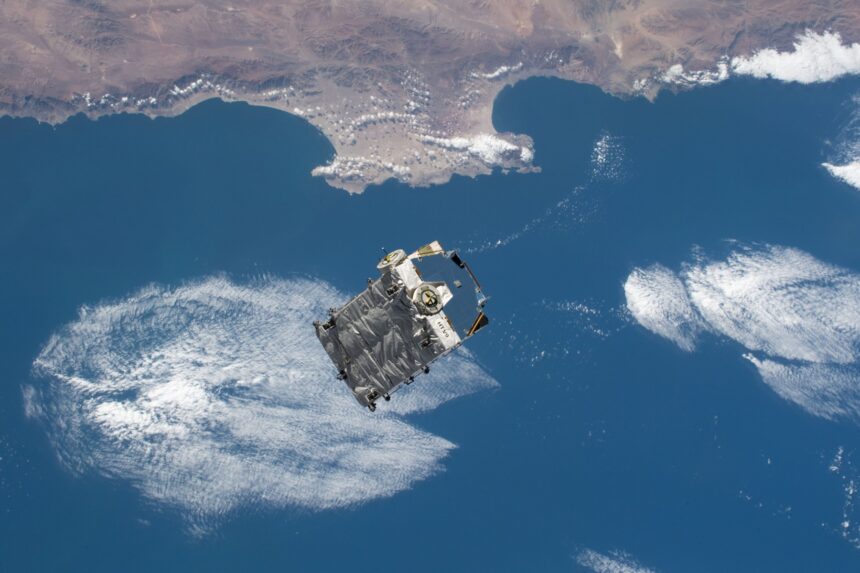
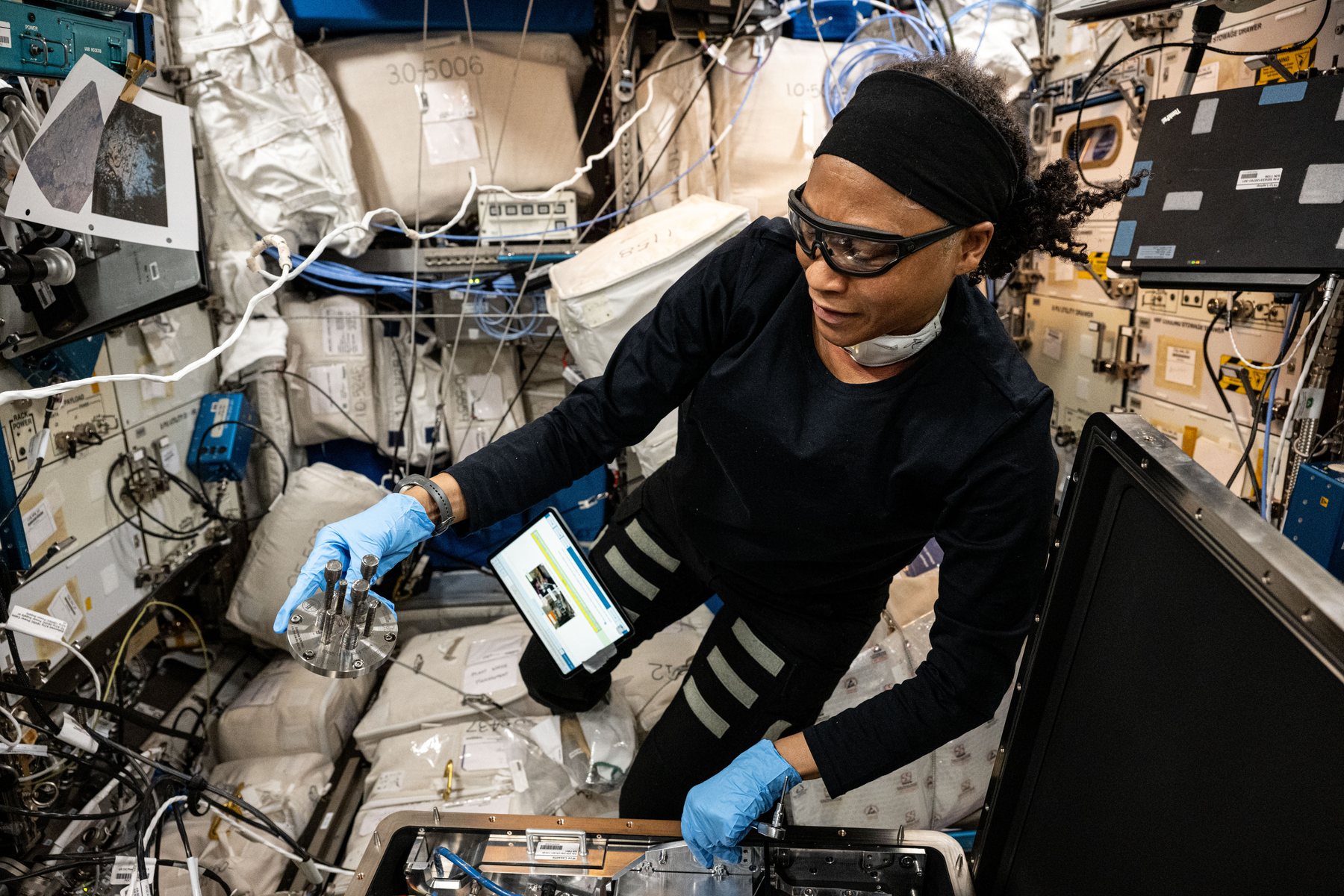
The station’s European laboratory, Columbus, now hosts experiments in in-space manufacturing, including the metal 3D printer pictured above. Under Article 21, a process run in that laboratory is treated, for intellectual property purposes, as carried out in a European partner State.
Who owns the invention?
Where an invention is made is not the same question as who owns it. That is usually settled by contract and employment law, and for US government missions by statute.
Under 51 U.S.C. 20135, an invention made in the performance of work under a NASA contract “shall be the exclusive property of the United States” if the Administrator determines that it falls within the employment and contribution tests in the section, and a patent is then issued to the United States unless the Administrator waives the government’s rights. Every NASA contract must also require prompt reporting of inventions. Companies flying research to the station under NASA arrangements need to read those clauses before they launch, not after.
Export controls add another layer. Technical data about a patented space process may be controlled under ITAR or the EAR, which affects who can be told about it and where an application can be filed. Our guide to satellite export controls covers those rules.
Copyright in orbit: the Space Oddity licence
Copyright raises the same territorial issue, and the best-known case shows that the rights in a work do not disappear because it was performed in orbit. In 2013 Canadian astronaut Chris Hadfield recorded a version of David Bowie’s Space Oddity aboard the station. On 13 May 2014 it came down from YouTube. Hadfield explained, as reported by NPR, that “we had permission for a year”. The video returned that November after the licence was renewed for two years, according to The Globe and Mail.
Anyone producing content in orbit needs the same clearances for music and other underlying works as on Earth.
Photographs work the other way for NASA. Under 17 U.S.C. 105, copyright protection “is not available for any work of the United States Government”. NASA’s media usage guidelines say its images and media “generally are not subject to copyright in the United States”, while asking users to credit NASA and not imply endorsement. That is why the photographs on this site are NASA’s. The same rule does not apply to photographs taken by astronauts of other agencies or by private astronauts, whose rights depend on their own contracts and law.
Commercial stations and the gap after the ISS
The Intergovernmental Agreement covers the ISS and nothing else. When the station is retired, a subject covered in our piece on ISS retirement and what replaces it, the detailed Article 21 regime goes with it.
For a station registered by the United States, 35 U.S.C. 105 will apply. For a station built by a US company but carrying a module registered by another State, the statute steps back for that module unless an agreement says otherwise, and the other State’s law may contain no equivalent rule at all. A company running a manufacturing line in such a module could find that its home patent does not reach the module, and that no other patent does either. Operators planning multinational stations would be wise to address intellectual property in the intergovernmental and commercial agreements from the start, using Article 21 as the model.
What I would watch
The first is how commercial station agreements handle intellectual property. If the partners in a private station sign anything resembling the ISS agreement, look for an Article 21 equivalent. If they do not, expect disputes to turn on the registry of individual modules.
The second is lunar activity. Section 105 depends on a “space object”. As lunar landers, habitats and processing plants multiply, someone will ask whether a process run in the open on the lunar surface is within any national patent law at all.
The third is whether other countries legislate. The United States has had a space patent clause since 1990. Few others have, and the growing number of national space laws would be the natural place to add one.
Questions people actually ask
Can you patent an invention made in space?
Yes. An invention made in space can be patented like any other, provided it meets the usual tests. The harder question is which country’s law applies. In the United States, 35 U.S.C. 105 treats an invention made, used or sold on a space object under US jurisdiction or control as made, used or sold in the United States.
Which country's patent law applies on the International Space Station?
Under Article 21 of the 1998 ISS Intergovernmental Agreement, activity in or on a station element is deemed to occur only in the territory of the partner State that registered that element. For ESA-registered elements, any European partner State may treat the activity as occurring in its territory, with rules preventing double recovery for the same infringement.
Who owns inventions made under a NASA contract?
Under 51 U.S.C. 20135, an invention made in the performance of work under a NASA contract can be the exclusive property of the United States if the Administrator determines that the statutory tests are met, unless NASA waives its rights. Contracts must also require prompt reporting of inventions to NASA.
Are NASA photos taken in space copyrighted?
Generally not in the United States. Under 17 U.S.C. 105, copyright is not available for works of the US government, and NASA’s media guidelines say its images generally are not subject to US copyright. NASA asks users to credit it and not to imply endorsement. Photographs taken by other agencies’ or private astronauts may be protected.
Why was Chris Hadfield's Space Oddity video taken down?
Hadfield said his team had permission to use the song for one year, and the video was removed on 13 May 2014 when that licence expired. It returned in November 2014 after the licence was renewed for two years. The episode shows that copyright in a song still applies when it is performed in orbit.
What happens to space intellectual property rules when the ISS is retired?
The ISS Intergovernmental Agreement covers only the ISS, so its Article 21 regime will not automatically carry over to commercial stations. US-registered stations will fall under 35 U.S.C. 105, but modules registered by other States will depend on those States’ laws or on new agreements between the partners.

Rahul BaggaFounder and Advisor, Space Law Journal
Rahul Bagga is a Partner at Dentons Link Legal and a Founder and Advisor of Space Law Journal.
Space Law Journal is a joint initiative of Legal Desire Media and Odyogeek. Spotted something we got wrong, or want to respond? Write to space@legaldesire.com.