What Is a Space Act Agreement? How NASA Funds Partners Without Buying From Them
What is a Space Act Agreement? How NASA's other transaction deals work, the four types, how they differ from FAR contracts, and what they mean for liability.
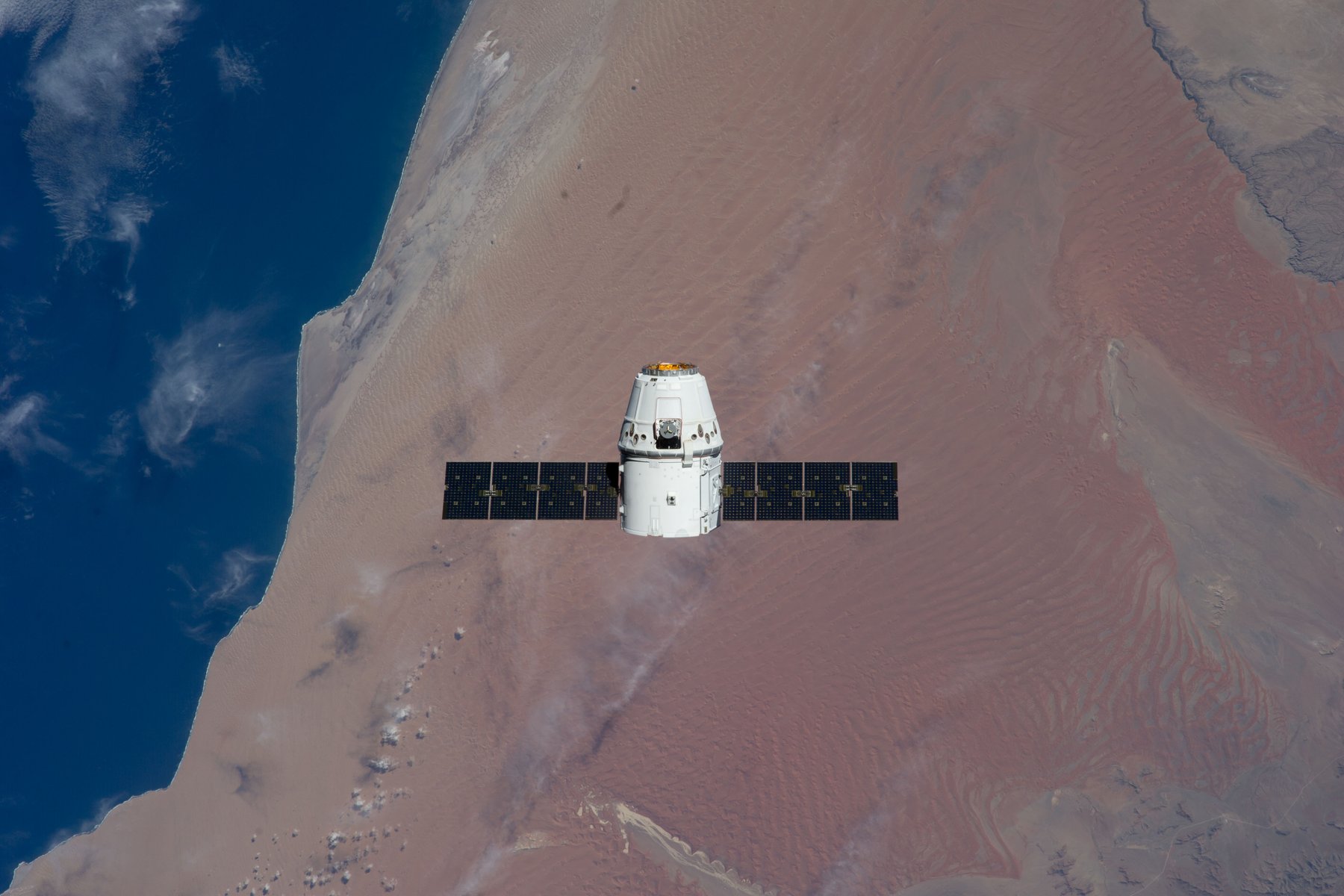
The spacecraft in the photograph is SpaceX’s Dragon on 25 May 2012, approaching the International Space Station over the Namib Desert before it was grappled and berthed on the COTS demonstration flight. NASA did not buy it. NASA paid SpaceX to help develop it under a Space Act Agreement worth $278 million when signed in August 2006, later increased to $396 million, according to a 2013 audit by NASA’s Inspector General.
That arrangement, NASA paying for capability it does not own, is what makes Space Act Agreements unusual. They are one of the main ways NASA works with companies, universities and foreign agencies. This explainer covers what they are, the kinds that exist, how they differ from contracts, and what they mean for liability and intellectual property.
What is a Space Act Agreement?
The legal basis is a single sentence in the National Aeronautics and Space Act. 51 U.S.C. 20113(e) authorises NASA “to enter into and perform such contracts, leases, cooperative agreements, or other transactions as may be necessary in the conduct of its work and on such terms as it may deem appropriate”, with any government body or “any person, firm, association, corporation, or educational institution”. The words “other transactions” are the source of the power.
NASA’s Space Act Agreements Guide (NAII 1050-1E) defines the result. Space Act Agreements “establish a set of legally enforceable promises between NASA and the Partner to the SAA requiring a commitment of NASA resources (including goods, services, facilities, or equipment) to accomplish stated objectives.” The guide says they are generally “not subject to restrictions on or regulations implementing” the statutes that govern grants, cooperative agreements, FAR contracts and cooperative research and development agreements.
The newer NASA Partnerships Guide (NAII 1050-3D, last updated 7 April 2026) is blunter: Space Act Agreements “are not procurement actions, and NASA’s OTA is not a contracting authority. Therefore, procurement procedures do not apply.” It adds that “NASA does not acquire goods and services for the direct benefit of the Government through partnership mechanisms.” If NASA wants to buy something for its own use, it must use a contract.
What kinds of Space Act Agreement are there?
The Partnerships Guide sets out the categories by who pays whom.
| Type | Money flow | Typical use |
|---|---|---|
| Reimbursable | Partner pays NASA’s costs | A company rents a NASA test facility, wind tunnel or engineering expertise not reasonably available commercially |
| Nonreimbursable | No exchange of funds; each side bears its own costs | Joint research, data sharing, cooperation with other agencies and foreign space agencies |
| Unfunded | No funds, but NASA provides goods, services or expertise to a domestic partner, chosen by competition | Supporting commercial spaceflight projects, such as the Collaborations for Commercial Space Capabilities initiatives |
| Funded | NASA transfers appropriated funds to a domestic partner, chosen by full and open competition | Developing commercial cargo, crew transport and space station capabilities |
Reimbursable agreements are for activities that “primarily benefit the partner”. NASA enters them only where it has goods, services or facilities “not reasonably available from the U.S. commercial sector” that it can offer without interfering with its own mission. Nonreimbursable agreements cover “a mutually beneficial activity” where “each party bears the cost of its participation”.
The last two categories are where commercial space policy happens. An unfunded agreement gives a company access to NASA’s people and know-how where “there is no direct benefit to NASA”. In June 2023 NASA signed unfunded agreements with seven companies, including Blue Origin, SpaceX, Sierra Space and Vast, under its second Collaborations for Commercial Space Capabilities round, with NASA contributing “technical expertise, assessments, lessons learned, technologies, and data”.
A funded agreement is one “in which NASA transfers appropriated funds to a domestic partner to accomplish an Agency objective where NASA does not take possession or ownership of deliverables as it would under a procurement contract”. The guide says funded agreements “may be used when the Agency cannot accomplish its objectives through the use of a procurement contract, grant, or cooperative agreement, and only after full and open competition.”
Agreements with foreign governments and agencies are a further category, international Space Act Agreements, governed by chapter 4 of the guide.
How is a Space Act Agreement different from a contract?
The practical differences follow from the fact that NASA is a partner, not a buyer.
No FAR. The Federal Acquisition Regulation and the NASA FAR Supplement do not apply. Terms are negotiated, and the clauses come from NASA’s guides, not from the FAR’s standard clauses.
No ownership of the result. Under a funded agreement NASA pays for milestones but does not own what is built. SpaceX kept Dragon. If NASA later wants a service, it must buy it under a contract.
Shared cost. Partners usually invest their own money. The Inspector General found that SpaceX and Orbital had contributed “more than 50 percent of the funds needed for spacecraft development” under COTS.
Competition for fairness, not compliance. Section 841 of the NASA Transition Authorization Act of 2017 says “NASA shall, to the greatest extent practicable, issue Space Act Agreements on a non-exclusive basis”, and NASA competes funded agreements. The Partnerships Guide explains that competition is used “to ensure fairness and transparency, not for procurement compliance.”
Termination. Space Act Agreements contain their own termination clauses. For low-risk agreements, the guide suggests either party may terminate on thirty days’ notice. The FAR rules on termination for convenience, which govern how a terminated contractor is paid, do not apply.
The COTS programme shows the model, including the risks. In 2006 NASA signed agreements with SpaceX for $278 million and Rocketplane Kistler for $207 million. When Rocketplane Kistler missed financial and technical milestones, NASA terminated its agreement in 2007 after spending $32.1 million, and in February 2008 signed a replacement agreement with Orbital worth up to $170 million. Once both companies had the capability, NASA bought the service: in 2008 it awarded $3.5 billion in fixed-price Commercial Resupply Services contracts under the FAR, $1.6 billion to SpaceX for 12 missions and $1.9 billion to Orbital for 8.
That is the two-step pattern: a Space Act Agreement to develop the capability, then a contract to buy the service.
How do liability and intellectual property work?
Because the Space Act lets NASA agree “such terms as it may deem appropriate”, risk allocation is a matter for the agreement. The Space Act Agreements Guide sets the default policy. Each party bears the risk of damage to its own property and people caused by its own actions, and the risk of third-party damage it causes. In nonreimbursable agreements, each party waives claims against the other for first-party damage, “a cross-waiver of claims”, unless caused by wilful misconduct. In reimbursable agreements the partner gives a one-way waiver in NASA’s favour.
Cross-waivers must “flow down” to contractors, subcontractors, customers and users, so that a whole chain of companies agrees not to sue each other. That is the same structure used in launch contracts, covered in our piece on launch services agreements and cross waivers. For high-risk activities NASA usually requires the partner to insure, because the federal government self-insures and generally may not buy insurance without statutory authority.
Intellectual property is negotiated within standard clauses on data rights, rights in raw data, inventions and patents. The guide notes that these clauses also provide the basis for protecting information from release under the Freedom of Information Act, including information protected under 51 U.S.C. 20131(b). For a company, the data rights clause is often the most valuable part of the agreement. Our article on inventions made in space explains why ownership of inventions in orbit is not as simple as it looks.
Why did NASA move commercial space stations between agreements and contracts?
The commercial space station programme shows how the choice of instrument is a policy decision.
On 2 December 2021 NASA signed funded Space Act Agreements worth $415.6 million in total with Blue Origin ($130 million), Nanoracks ($160 million) and Northrop Grumman ($125.6 million) for the first phase of commercial low Earth orbit destinations, with the aim that “NASA is one of many customers”.
On 4 August 2025, a directive signed by Acting Administrator Sean Duffy dropped the planned FAR-based firm fixed price Phase 2 contract and said NASA would “continue to support U.S industry’s design and demonstration of CLDs with multiple funded SAAs for the next phase”, with a later FAR-based certification phase. The minimum capability became four crew for one-month stays.
The approach changed again in 2026. NASA’s Commercial LEO Destination Contract page shows a draft request for proposals on 6 July 2026, a final request on 9 October 2026 and an amendment on 9 November 2026, with proposals planned for 8 December 2026 and award in spring 2027. Reporting on the draft described FAR-based contracts awarded through full and open competition. I have not seen a NASA document explaining the switch back from agreements, so I would not assume the reasons.
The trade-off is clear enough. An agreement gives companies flexibility and lets NASA share cost, but gives the partner less certainty and gives NASA less control. A contract gives NASA requirements it can enforce and gives the company a customer, at the price of FAR compliance. With the International Space Station due to retire, as covered in our piece on what replaces the ISS, that choice has a direct effect on whether a replacement is ready in time.
Who can sign one?
Almost anyone: the statute covers government bodies and “any person, firm, association, corporation, or educational institution”. Funded and unfunded agreements are limited to domestic partners, and agreements with or benefiting foreign entities need early coordination with NASA’s Office of International and Interagency Relations. Space Act Agreements also sit behind newer partnerships for in-orbit servicing, as our analysis of the Swift rescue mission shows.
What I would watch
The first is the Commercial LEO Destination Contract award planned for spring 2027. If NASA picks providers under a FAR contract, the commercial station programme will have moved from agreements to procurement earlier than the 2025 directive planned, and the terms will show how much risk NASA is willing to carry.
The second is the 2026 rewrite of NASA’s partnership guidance. The April 2026 Partnerships Guide revised the agreement type definitions and the review process. Companies negotiating agreements should check which version their counterparts are using.
The third is whether other agencies copy the model. The Weather Act passed by the Senate on 10 November 2026 would extend NOAA’s comparable “additional forms of transaction” authority to 2035, and NASA’s record, both COTS and Rocketplane Kistler, is the best evidence of how such authority works in practice.
Questions people actually ask
What is a Space Act Agreement?
A Space Act Agreement is a legally enforceable agreement between NASA and a partner made under the “other transactions” authority in 51 U.S.C. 20113(e). It commits NASA resources such as facilities, expertise or funding to shared objectives. It is not a procurement contract and the Federal Acquisition Regulation does not apply.
What is the difference between a funded and unfunded Space Act Agreement?
Under a funded agreement NASA transfers appropriated money to a domestic partner to reach an agency objective, without taking ownership of the result, and only after full and open competition. Under an unfunded agreement NASA provides goods, services, facilities or expertise to a domestic partner but no money.
Is a Space Act Agreement a contract?
It is a binding agreement but not a procurement contract. NASA’s 2026 Partnerships Guide says Space Act Agreements are not procurement actions and that NASA’s other transaction authority is not a contracting authority. When NASA wants to buy goods or services for its own use, it must use a FAR contract.
Which spacecraft were developed under Space Act Agreements?
SpaceX’s Dragon and Orbital Sciences’ Cygnus cargo spacecraft were developed with funding under the Commercial Orbital Transportation Services programme. SpaceX’s 2006 agreement was worth $278 million, later $396 million, and Orbital’s 2008 agreement up to $170 million, later $288 million. NASA then bought cargo flights under fixed-price contracts.
Who is liable if something goes wrong under a Space Act Agreement?
Under NASA’s default policy each party bears the risk of damage it causes. In nonreimbursable agreements the parties cross-waive claims for damage to their own property and people, except for wilful misconduct, and flow the waiver down to contractors. In reimbursable agreements the partner waives claims against NASA and may have to insure high-risk activities.
Can a foreign company sign a Space Act Agreement with NASA?
Yes, through an international Space Act Agreement, which NASA uses for cooperation with foreign agencies and entities. Funded and unfunded agreements are limited to domestic partners, and any agreement with or benefiting a foreign entity needs early coordination with NASA’s Office of International and Interagency Relations.

Anuj KumarEditor-in-Chief
Anuj Kumar is the founder of Legal Desire Media and publishes Fashion Law Journal and Space Law Journal.
Space Law Journal is a joint initiative of Legal Desire Media and Odyogeek. Spotted something we got wrong, or want to respond? Write to space@legaldesire.com.